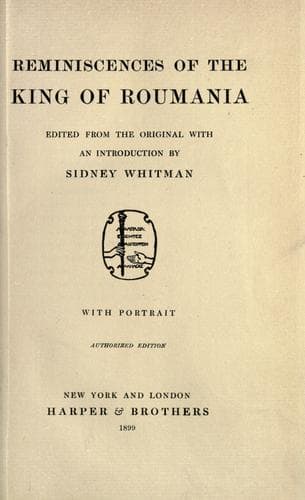
Reminiscences of the King of RoumaniaKremnitz, Mite
History
Reminiscences of the King of Roumania
Kremnitz, Mite
Carol I, King of Romania, 1839-1914; Eastern question (Balkan); Jews -- Romania; Romania -- History -- Charles I, 1866-1914
"We quitted Sinaja three weeks ago with heavy hearts to return to
Bucharest. The weather remained beautiful until a week ago, and
our longing for the mountains was increased; the more so as the
empty rooms of the Palace can never appear lively. We endeavour to
distract ourselves as much as possible and invite people to dinner
every day, but nothing can make us forget the dear voice of our
child, which we miss everywhere and at all times.
"I opened the Chamber yesterday. My speech was short, and touched
only on practical questions.
"The question of the commercial treaties is on the high road to an
immediate solution, the only difficulties are matters of detail.
We are now negotiating with Austria-Hungary, whose interest it
is to enter on closer relations with us both politically and
commercially. Even now the Porte cannot grow resigned to a defeat
which is due to its own lack of skill. England, France, and Italy
will have no course left but to adopt the same line as the three
other Great Powers; their representatives here are quite willing
to influence their Governments in our favour. We have every reason
to be satisfied with our Diplomatic Corps; France and England, in
particular, have sent us amiable and experienced men, who have
already travelled throughout the country, and can judge of our
circumstances with intelligence. They have both pleaded for the
commercial conventions in their reports."
* * * * *
A most interesting and important report on the condition of the
Servian forces in 1874 was received on January 9, 1875. M. Sturdza
prefaced his remarks by insisting upon the extreme difficulty
of ascertaining the truth about Servia: Chauvinism and love of
exaggeration conspired to keep strangers in the dark. He had,
however, been able to discover enough to prove that the Servian
troops were, strictly speaking, no army at all. Both quality and
quantity left much to be desired, whilst the standing force of
5000 men was hardly sufficient to keep order in the interior. The
permanent force of cavalry amounted to but one solitary squadron,
whilst only one battery was armed with modern guns. The fortresses
were in an indefensible condition, as their sole armament consisted
of the guns which the Turks had left there. The Territorial Army
was of still less value than the standing army. Without officers
and without equipment or proper arms it in no way deserved serious
consideration. The political situation of Servia also gave rise to
considerable doubt as to the stability of Prince Milan's Government.
The Press constantly urged the Croats, Slavonians, and Hungarian
Servians to rebel against Austria. Prince Milan had flouted Germany
by his openly expressed sympathy with France, whilst England's
favour had been lost by the anti-Turkish policy of the Ministry.
Russia, Servia's best friend, had supported the Ministry, until
it applied to the French Ambassador in Constantinople for his
assistance in the Swornik question.
Public-domain text, read in full here on John Shaqi.
Reviews
Reviews
No reviews yet
Be the first to share your thoughts on this work.
Elsewhere in the archive
Join the Discussion
Join the discussion
Sign in to leave a comment or review.
Sign InorCreate an account