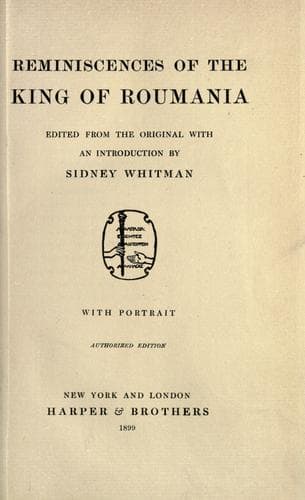
Reminiscences of the King of RoumaniaKremnitz, Mite
History
Reminiscences of the King of Roumania
Kremnitz, Mite
Carol I, King of Romania, 1839-1914; Eastern question (Balkan); Jews -- Romania; Romania -- History -- Charles I, 1866-1914
"The Austrian representative inquires what we shall do in the event
of Russian troops occupying the country; the Russian sounds us
to find out whether we repose any confidence in Austria-Hungary;
but both adjure us not to act hastily. They desire peace, because
they grudge each other the solution of the Eastern Question, and
because neither is prepared for war. It cannot be denied that we are
suffering from this indecision, and are exposed to every possible
danger. So much is certain, that Russia is concentrating troops on
the Moldavian frontier, and that General Ignatieff declared to the
Turkish Ministers in the presence of my representative, Prince Jean
Ghika, that his Government would seize the Danube Principalities as
a pledge as soon as the Turks occupied Servia and Montenegro! It is,
of course notorious that you cannot weigh every word of the Russian
Ambassador in Constantinople in a goldsmith's scales; yet we must
not ignore these heedless comments.... We are resolved to repel with
armed force any occupation, no matter from which side it comes. We
naturally cannot hold out against a Great Power, yet we shall be
able to preserve our standing point without, as formerly, meeting
the army of occupation as our saviours....
"Matters are not progressing favourably in Servia. The population
of that portion of the East has fixed its eyes on Montenegro, which
enjoys great authority amongst the Slavs, and great respect from the
Turks. Prince Nicholas, with whom I am on the best terms, is treated
with especial consideration and leniency by Russia and Austria, a
thing which unfortunately cannot be said of the young Milan."
* * * * *
On April 6, 1876, Prince Milan sent his uncle, M. Catargiu, to
inform Prince Charles that he had decided on war with Turkey, and
hoped that Roumania would not remain content with the _rôle_ of
a passive spectator, as it was to the interest of both countries
to free themselves from the Turkish suzerainty. Prince Charles,
however, did not abandon the strict reserve with which he had
hitherto received similar communications.
The startling news of a deficit of 30,000,000 francs, at a time when
the political situation rendered an increased expenditure on the
army essential, led on April 11, 1876, to the fall of the Catargiu
Ministry, which for five eventful and, on the whole, prosperous
years had assisted Prince Charles in the consolidation of the
Principalities. General Floresku was entrusted with the formation
of the new Cabinet, which, as it included two other generals,
was promptly dubbed the "Cabinet of Generals" by the Opposition
Press. Strange to say, the life of this _quasi_-military government
depended on the votes of the eight bishops, as the supporters of the
Government disposed of thirty-seven, and the Opposition thirty-four
votes in the Senate.
_To_ PRINCE CHARLES ANTHONY, _April 26th, 1876_.
Public-domain text, read in full here on John Shaqi.
Reviews
Reviews
No reviews yet
Be the first to share your thoughts on this work.
Elsewhere in the archive
Join the Discussion
Join the discussion
Sign in to leave a comment or review.
Sign InorCreate an account