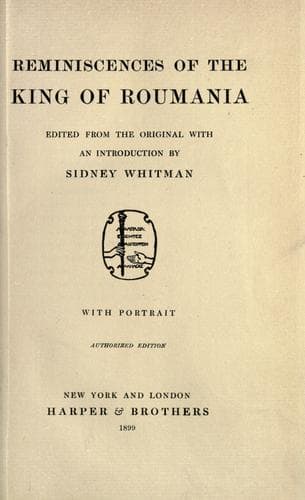
Reminiscences of the King of RoumaniaKremnitz, Mite
History
Reminiscences of the King of Roumania
Kremnitz, Mite
Carol I, King of Romania, 1839-1914; Eastern question (Balkan); Jews -- Romania; Romania -- History -- Charles I, 1866-1914
"I heard to-day of the mobilisation of the Roumanian army and
its concentration in Northern Moldavia! What is to be understood
by that? Is the march of the Russians through the country to be
opposed; or will Roumania side with Russia? All this is not clear to
me! The pusillanimous policy of England has completely entangled the
whole Turkish-Christian Question. Austria-Hungary is crippled by its
dualism, the German Empire is shrouded in aristocratic silence, and
only Russia perseveres with an iron persistence in her far-reaching
aims."
* * * * *
In reply to an _ultimatum_ presented by General Ignatieff, the
Sublime Porte conceded an armistice of two months, commencing
on November 1, to apply to the Servian and Montenegrin forces
alike. Prince Milan's troops, under the command of Tschernaiew,
had suffered defeat after defeat at the hands of the Turkish
troops, and were again saved from annihilation only by the direct
intervention of Russia.
_From the_ GERMAN CROWN PRINCE, _November 18th_.
"... I received the following from Prince Bismarck: 'The situation
of the Prince is serious, although I am not convinced that Russia
will proceed to war, if nobody endeavours to restrain her from doing
so.
"'In the event of war, I do not think Prince Charles ought to
resist the Russian proposals too seriously, nor throw himself into
their arms. It would be best if he shielded himself behind his duty
towards the Porte, and then yielded to force, which will probably be
applied from the North long before Turkey assumes the offensive.
"'He must not allow himself to be led away by ambition, but must
adhere to the treaties: his resources are not sufficient in the
face of two such armies to secure him the respect of the victor, if
he employs his forces. So long as he adheres to the treaties, he
can always appeal to Europe. That will always be a claim, though
not perhaps an indisputable one; still it will carry great weight
should the Russian campaign prove unfortunate eventually. I offer my
opinion here as if I were a Roumanian, and not a German Minister,
solely on account of my personal interest for his Highness!'"
* * * * *
Six Russian Army Corps were mobilised and placed under the command
of the Grand Duke Nicholas, as the Army of the South, on November
14, 1876. A circular note to the Powers assigned as the reason
for this step the futility of all diplomatic efforts to protect
the Christians of Turkey from the attacks of the Mohammedans. The
Czar, though desirous of peace, had therefore mobilised a portion
of his army, in order to obtain guarantees for the execution of the
principles proposed by Europe.
Public-domain text, read in full here on John Shaqi.
Reviews
Reviews
No reviews yet
Be the first to share your thoughts on this work.
Elsewhere in the archive
Join the Discussion
Join the discussion
Sign in to leave a comment or review.
Sign InorCreate an account