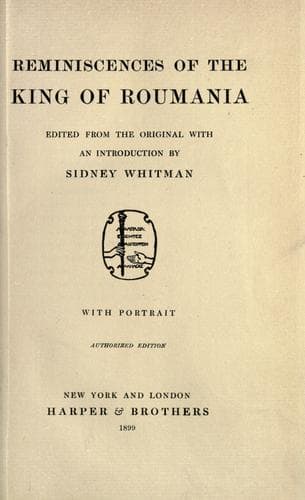
Reminiscences of the King of RoumaniaKremnitz, Mite
History
Reminiscences of the King of Roumania
Kremnitz, Mite
Carol I, King of Romania, 1839-1914; Eastern question (Balkan); Jews -- Romania; Romania -- History -- Charles I, 1866-1914
Prince Charles replied that he intended to keep his troops under
his own command, but that the Russians would be benefited by having
their right flank secured. The Roumanian garrisons of Oltenitza and
Giurgiu would not retire until relieved by Russian troops. At the
same time he declared himself anxious to take an active part in the
war, but only on condition that his proposals were agreed to.
The Grand Duke returned the Prince's visit on the following day, May
15, accompanied by his son and a numerous suite, which included M.
de Nelidow, who had conducted the negotiations with Roumania, and
was now in charge of the diplomatic correspondence at headquarters.
In reply to an inquiry in the Chamber on May 21, Cogalniceanu
declared that Roumania was practically independent, as Europe would
not force her to return to her former bondage. It was then decided
by a large majority to create an order, "The Star of Roumania," as
the first act of Roumanian independence. This order consists of five
classes--viz., Knight, Officer, Commander, Grand Officer, and Grand
Cross,--whose members wear a star of eight rays depending from a
crown and surcharged with a cross in blue enamel, which displays the
eagle of Wallachia. The ribbon is red, bordered with blue, and the
motto runs: _In fide salus_.
Prince Charles Anthony entirely agreed with his son's attitude
towards Russia, and stigmatised the mooted co-operation, with its
inevitable subordination and incorporation in the Russian army, as a
"political _felo de se_."
"The _possibility of a Russian defeat_," he wrote, "no matter how
improbable, must also be considered: an untouched reserve on this
side of the Danube, which could only consist of the Roumanian army
intact, would in that case possess an immense importance!"
Prince Charles, accompanied by his Staff, set out on the 27th
to inspect his troops at Crajowa and Calafat, and found them in
excellent order and discipline. At 7 P.M. the Prince ordered the
bombardment of Widin to commence, and a lively cannonade ensued,
during which three Turkish shells exploded in the immediate
neighbourhood of the Prince. The _sangfroid_ of their ruler did
not fail to arouse a feeling of appreciation in the Roumanian
nation, who on his return greeted him everywhere with indescribable
enthusiasm.
The Czar in the meantime declared that, if the Roumanian Government
wished to take part in the campaign, it must do so at its own
expense and risk, and must, moreover, place the army under the
command of the Grand Duke. "Russia has _no need_ of the support of
the Roumanian army. The force which has been put into the field
against Turkey _is more than sufficient_ to achieve the high object
which the Czar had in view in commencing the present war."
Public-domain text, read in full here on John Shaqi.
Reviews
Reviews
No reviews yet
Be the first to share your thoughts on this work.
Elsewhere in the archive
Join the Discussion
Join the discussion
Sign in to leave a comment or review.
Sign InorCreate an account