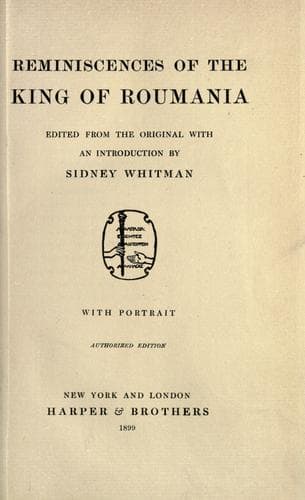
Reminiscences of the King of RoumaniaKremnitz, Mite
History
Reminiscences of the King of Roumania
Kremnitz, Mite
Carol I, King of Romania, 1839-1914; Eastern question (Balkan); Jews -- Romania; Romania -- History -- Charles I, 1866-1914
* * * * *
The first ambassador to the Roumanian Court, Count Hoyos, was
sent by Austria, an example soon followed by Turkey, and later on
by Russia, who raised the rank of its representative first from
Consul-General to Resident Minister, and then to Ambassador. In
return, the Diplomatic Agents of Roumania in Vienna, St. Petersburg,
and Constantinople were created Ambassadors. A very friendly
understanding with Turkey was now initiated, and proved to be of
great advantage to Roumania during the transactions of the Frontier
Commission, which was presided over by the former State. In strict
accordance with the provisions of the Treaty of Berlin, the frontier
line was fixed close to the gates of Silistria, in spite of the
immediate protests of the Russian Commissary, who succeeded in
delaying a final settlement for a period of years.
On November 26, 1878, the Roumanians proceeded to take possession of
the Dobrudscha, and were received with the greatest enthusiasm, to
the surprise of the Austrian Emperor, whose experience in Bosnia had
led him to advise Prince Charles not to garrison the Dobrudscha with
less than a Division.
The first anniversary of Plevna was marked by the issue of a
stirring Army Order by Prince Charles, who also exchanged warm
congratulations by telegraph with the Czar and the Archduke Nicholas.
Rumours in the Press pointed to the probable selection of Prince
Alexander of Battenberg for the newly created throne of Bulgaria,
whilst the selection of Prince Charles also received public support.
In reply to his Ministers, who considered that his candidature was
desirable, Prince Charles remarked that the moment for such a step
had passed. Not _against_, but only _with_ the aid of Russia could
such a candidature succeed!
Although the Chamber and Senate at first supported the speedy
convocation of a _Constituante_, months elapsed before the
three readings took place in the Chamber before proceeding to a
dissolution to allow the elections to take place.
The third reading did not take place till April 5, 1879, after
Prince Bismarck had in a somewhat threatening manner requested
to be informed when the Jewish question was to be settled. This
question was transmitted through Austria-Hungary, the Roumanian
representative in Berlin being passed over!
In addition to this pressing question of the Jewish franchise, the
old trouble about the re-purchase of the Strousberg Railway Line
was raised by Germany, which roundly declared that her attitude in
future depended on this measure being carried out.
The Prince of Roumania wrote to Prince Charles Anthony:
"Although we wish to acquire the railway lines, we nevertheless
feel hurt at this pressure. The Jewish question, and the
purchase of the railways are two such important problems that
they can hardly be grappled with simultaneously. Bleichröder's
influence is evident in both affairs.
Public-domain text, read in full here on John Shaqi.
Reviews
Reviews
No reviews yet
Be the first to share your thoughts on this work.
Elsewhere in the archive
Join the Discussion
Join the discussion
Sign in to leave a comment or review.
Sign InorCreate an account