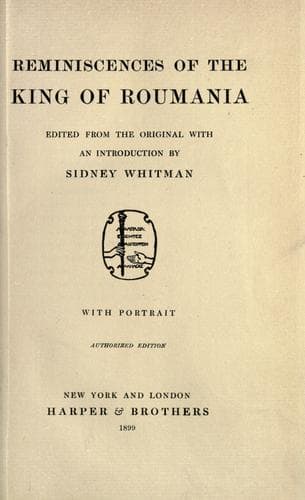
Reminiscences of the King of RoumaniaKremnitz, Mite
History
Reminiscences of the King of Roumania
Kremnitz, Mite
Carol I, King of Romania, 1839-1914; Eastern question (Balkan); Jews -- Romania; Romania -- History -- Charles I, 1866-1914
"In the event of an unsatisfactory solution, they are determined
in Berlin to intervene by means of a Collective Note which will
dictate to us what rights we are to concede to the Jews. Such a
step would, of course, arouse national excitement, and only further
increase resistance; but this might become a great danger to the
country apart from the humiliation which it includes. The question
is whether execution would follow intervention, and what shape the
execution would take? Italy contents itself with the removal of
Article VII. of the Constitution, and likewise England, with the
naturalisation of a few Jews. Waddington, however, demands a radical
solution, and Berlin insists on the re-purchase of the railways
under the conditions imposed by her bankers. The German Chancellor
is opposed to us, and all the goodwill of the Emperor is of no
avail."
* * * * *
Prince Bismarck informed the Roumanian Government through Count
Andrassy that he placed no confidence in their good faith, and
that, in his opinion, Roumania was still a dependent State. In
the event of her resisting the resolutions of the Berlin Congress
he intended to treat with the Suzerain at Constantinople! Count
Andrassy in vain represented the difficulty of the Roumanian
situation, for Prince Bismarck was armed with the argument that he
considered the honour of the German Empire pledged in this matter,
whilst England proposed a Collective Note to be executed by the
Austrian Cabinet. Yet, despite the threatening aspect of affairs,
the Roumanian Chambers became more and more obstinate, and refused
to hasten a solution of the constitutional questions involved.
The marriage of the Prince's youngest brother, Frederick, with
Princess Louise of Thurn and Paris, took place at Regensburg in June
1879, and the German Emperor and Empress celebrated their golden
wedding at Berlin. The same month, however, brought the terrible
news of the death of the unfortunate Prince Imperial, who had
volunteered for service with the British troops acting against the
Zulus. In reply to Prince Charles' letter of sympathy the Empress
Eugenie wrote:
"CHISLEHURST, _August 19th, 1879_.
"You recall to me the days of happiness, and by recurring to the
present you share my illimitable grief.
"Everything has fallen from me, and only two tombs are left of
all I loved. I rest near them, and here my isolation seems less
great. I have known both extremes and the want of stability
of human fortunes. We are wrong in not always fixing our eyes
beyond this life on that one where nothing changes, and where we
shall rejoin those whom we love to all eternity.
"I beg that you will thank the Princess for the sympathy which
my recent and overwhelming misfortune has elicited from in her.
"EUGENIE."
The death of the German Crown Prince's third son, Waldemar, at the
early age of eleven, gave occasion to the following letter:
Public-domain text, read in full here on John Shaqi.
Reviews
Reviews
No reviews yet
Be the first to share your thoughts on this work.
Elsewhere in the archive
Join the Discussion
Join the discussion
Sign in to leave a comment or review.
Sign InorCreate an account