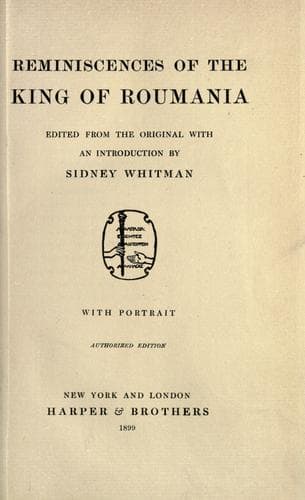
Reminiscences of the King of RoumaniaKremnitz, Mite
History
Reminiscences of the King of Roumania
Kremnitz, Mite
Carol I, King of Romania, 1839-1914; Eastern question (Balkan); Jews -- Romania; Romania -- History -- Charles I, 1866-1914
"This railway affair commenced with Dr. Strousberg, who dragged
the Silesian magnates into it, and with them all their friends
and dependents were in turn involved. To-day we find amongst the
bondholders of the Roumanian Railway Company, lords and ladies,
lackeys of the great houses, and even cabdrivers--in a word, almost
the whole of Berlin. Indeed, more than that, the King himself had to
intervene to save a few of the Silesian magnates, when Strousberg
could carry on no longer! He then applied to Bleichröder, who was,
however, rich enough not to need to address himself to so involved a
question. Nevertheless, he did so because he was asked, and also on
account of the credit which it brought him. He has taken the matter
in hand, and we are bound to support him. But the King has done even
more than this. He has had to assist the great Silesian nobles out
of his privy purse. It is, therefore, easy to understand that every
one is anxious to escape from this painful situation. You must,
therefore, solve these two questions in order to enter the ranks of
the Independent States. An independent Roumania will throw a heavy
weight into the balance of Oriental questions.... Roumania has an
area of 2500 square miles (German) and 6,000,000 inhabitants. It
might have 10,000,000; and how powerful it would be then."
* * * * *
The Jews were admitted to the franchise on October 18, 1879, by
an alteration of Article VII. of the Constitution, and over 900
Jews who had served with the colours in 1877-78 were immediately
admitted to the rights of citizenship. Though the situation at
one period became so critical that the German Empress sent a
"quite confidential" warning that delay was fraught with danger,
the demands of Germany in the matter of the railway purchase were
satisfied three months later, and the independence of the Roumanian
State was in consequence fully recognised by all the European Powers.
_To_ PRINCE CHARLES ANTHONY, _February 11th, 1880_.
"Sandro[22] is in despair about the doings of the Panslavists, who
are making his task uncommonly difficult; had he only Bulgarians
to deal with, he would get on easily enough.... He is determined
to speak openly to the Czar Alexander about the Panslavonic and
Nihilist agitation in Sofia. He returns to his capital at the end of
March, when the newly elected National Assembly will be opened; it
is not much better than the former. So long as the Czar Alexander
lives he will personally exert a favourable influence in Bulgaria,
but when he dies everything will be changed. I told Sandro, who has
much confidence in me, that if he possesses enough strength to live
down this period of suffering, he will be richly rewarded for his
patience and endurance. But few, perhaps, have the patience that I
had, and still have."
[22] Prince Alexander of Bulgaria.
Public-domain text, read in full here on John Shaqi.
Reviews
Reviews
No reviews yet
Be the first to share your thoughts on this work.
Elsewhere in the archive
Join the Discussion
Join the discussion
Sign in to leave a comment or review.
Sign InorCreate an account