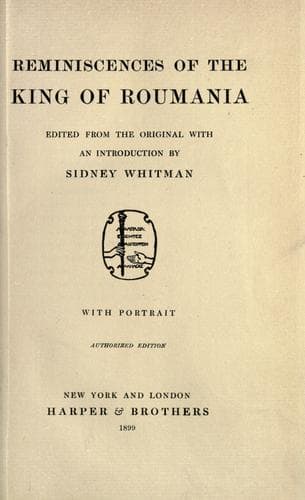
Reminiscences of the King of RoumaniaKremnitz, Mite
History
Reminiscences of the King of Roumania
Kremnitz, Mite
Carol I, King of Romania, 1839-1914; Eastern question (Balkan); Jews -- Romania; Romania -- History -- Charles I, 1866-1914
To return, however, to the affairs of Roumania; Prince Charles
opened the new mint at Bucharest in March, when the first Roumanian
coins bearing a profile of the Prince and the inscription "Prince of
the Roumanians" were struck. The coins consisted of _Carols d'or_
in gold and one _leu_ (franc) in silver. Ali Pacha at once protested
formally against the illegal coinage with the Prince's likeness,
and refused to allow it to circulate in Turkey. Owing, however, to
the support of Austria and France, this difficulty was eventually
smoothed over satisfactorily.
Financial difficulties, coupled with the unsatisfactory reports on
the Roumanian railway concessions, led to the fall of the Golesku
Ministry in April. M. E. C. Jepureanu succeeded in forming a new
Cabinet, which received cordial support from abroad as well as at
home. The vexatious Jewish question and the very serious state
of the railway finances, for which the Opposition sought to make
the Prince personally responsible, were the chief of the many
difficulties of the Government.
The result of the general election was by no means as favourable as
the Prince had been led to expect, and a serious riot occurred at
Pitéschti. The troops were called out and ordered to fire upon the
mob, several of the soldiers having been wounded by stones. Similar
occurrences took place at Plojeschti, a regular hot-bed of seditious
intrigue, and the National Guard of that town had to be subsequently
disbanded for taking part in the political demonstrations.
The attention of Prince Charles was suddenly averted by a change
in his eldest brother's views with regard to the Spanish throne.
Prince Leopold had at last decided to accept the crown under certain
definite conditions, as he had become convinced of the great
services which he could thus render to his Fatherland. King William
at once gave his consent, and Don Salazar returned to Madrid on
June 23 with the news of Prince Leopold's readiness to accept the
crown. An unfortunate mistake in a cypher telegram caused the Cortes
to be prorogued from June 24 to October 31, and the election of
Prince Leopold was therefore delayed until late in the autumn, thus
offering ample opportunities to malcontents for the prosecution of
intrigues and agitations against the Hohenzollern candidature.
Public-domain text, read in full here on John Shaqi.
Reviews
Reviews
No reviews yet
Be the first to share your thoughts on this work.
Elsewhere in the archive
Join the Discussion
Join the discussion
Sign in to leave a comment or review.
Sign InorCreate an account