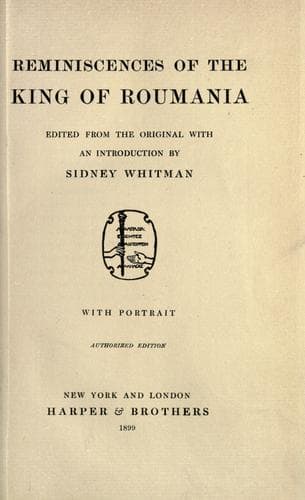
Reminiscences of the King of RoumaniaKremnitz, Mite
History
Reminiscences of the King of Roumania
Kremnitz, Mite
Carol I, King of Romania, 1839-1914; Eastern question (Balkan); Jews -- Romania; Romania -- History -- Charles I, 1866-1914
Prince Charles replied to Count Bismarck's letter on January 27,
1871, thanking him for the sympathy he had shown for the ruler of
Roumania, if not for the country itself, and assuring him of the
heartfelt interest and joy with which the recent military events
in France inspired him. He continued: "The situation here is
serious; for the present I can avail myself of the Party intrigues
to maintain my position as long as I consider it suitable and
advisable. I have to act like a ship's captain, who must remain
at his post day and night during a storm. The waves now sweep my
ship to the skies, now dash it down to the depths, but as surely
as God is my helper I will not let it be wrecked! To-day the crew
would willingly throw me overboard, but a few of them still possess
sufficient intelligence to know that I alone can steer them safely
into port.
"I will not lose sight of two points; I intend to bring my name
clean and unspotted out of this turmoil, but I will not heartlessly
and without a conscience leave _le déluge après moi_. This refers,
above all, to the finances, the desertion of which might be fraught
with grave danger both at home and abroad."
The letter already referred to, in which Prince Charles set forth
the reasons which led him to think of abdicating, was published in
the columns of the _Augsburger Allgemeine Zeitung_, and created the
greatest excitement in Roumania. A discussion in the Chamber upon
the authenticity of this document took place on February 11, 1871,
when a Deputy, N. Blaramberg, declared that either the letter
was a forgery, or that the Prince was about to abdicate and leave
Roumania to the tender mercies of its enemies. "A Prince who quits
his country in its hour of danger may be compared to a deserter or a
traitor to the State!"
The President of the Ministry was unable to deny the authenticity
of the document, but assured the Chamber that the views contained
in it, if they were ever actually current, prevailed no longer.
Cogalniceanu then proposed the following counter-resolution:
"The Chamber, deeply moved by the explanations communicated by
the Ministry, expresses its devotion to the Throne and Dynasty,
guaranteed by the Constitution, and proceeds to the order of the day
with every confidence in the future of the country, and in the firm
resolve to adhere to the Constitution."
An infinitely more loyal tone prevailed in the Senate, where
the contents of Prince Charles's letter were also discussed. A
resolution was carried with only four dissentients to the effect
that the chief duty of the Senate lay in supporting the Sovereign
whom the nation had so enthusiastically elevated to the throne, and
that the consolidation of the dynasty was indissolubly bound up with
the peace, existence, and political development of the country.
Public-domain text, read in full here on John Shaqi.
Reviews
Reviews
No reviews yet
Be the first to share your thoughts on this work.
Elsewhere in the archive
Join the Discussion
Join the discussion
Sign in to leave a comment or review.
Sign InorCreate an account