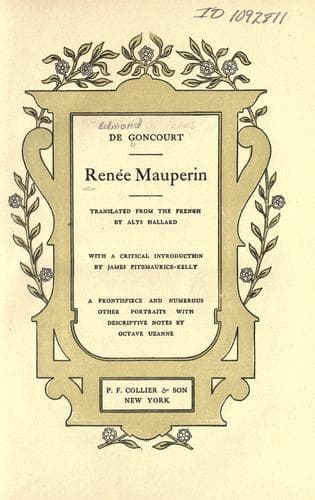
France -- Social life and customs -- 19th century -- Fiction
"That's the very thing, good! Will you call in and see mother first.
Tell her that I cannot come before Thursday. It would be awkward if she
happened to drop in on us just the next day or two. I shall not go out;
I'll have a bath and get a little more presentable. This mark doesn't
show very much now, does it? I shall send out for dinner, and then spend
the evening writing two or three necessary letters. By-the-bye, if you
see the gentleman to-morrow morning, why not have it out in the
afternoon at four o'clock? It's just as well to get it over. To-morrow
you'll find me here all the day--or else I shall be at the shooting
gallery. Arrange things as you would for yourself, and thanks for all
your trouble, old man. Four o'clock, then--if possible."
XXXV
The name of the farm that Henri Mauperin had added to his surname to
make it sound more aristocratic happened, by a strange chance, such as
sometimes occurs, to be the name of an estate in Lorraine and of a
family, illustrious in former days, but at present so completely
forgotten that every one believed it had died out.
The man who had just dealt Henri this blow was the last of those
Villacourts who took their name from the domain and chateau of
Villacourt, situated some three leagues from Saint-Mihiel, and owned by
them from time immemorial.
In 1303 Ulrich de Villacourt was one of the three lords who set their
seal to the will of Ferry, Duke of Lorraine, by order of that prince.
Under Charles the Bold, Gantonnet de Villacourt, who had been taken
prisoner by the Messinians, only regained his liberty by giving his word
never to mount a battle-horse, nor to carry military weapons again. From
that time forth he rode a mule, arrayed himself in buffalo-skin, carried
a heavy iron bar, and returned to the fight bolder and more terrible
than ever. Maheu de Villacourt married Gigonne de Malain and afterward
Christine de Gliseneuve. His marble statue, between his two wives, was
to be seen before the Revolution in the Church of the Grey Friars at
Saint-Mihiel. Duke Rene allowed him to take eight hundred florins from
the town of Ligny for the ransom that he had had to pay after the
disastrous battle of Bulgneville.
Remacle de Villacourt, Maheu's son, was killed in 1476, in the battle
waged by Duke Rene before Nancy against Charles the Daring. Hubert de
Villacourt, Remacle's sons, Seneschal of Barrois and Bailiff of
Bassigny, followed Duke Antoine as standard-bearer in the Alsatian war,
while his brother Bonaventure, a monk of the strict order of
Saint-Francois, was made three times over the triennial Superior of his
order, and confessor of Antoine and Francois, Dukes of Lorraine; and one
of his sisters, Salmone, was appointed Abbess of Sainte Glossinde of
Metz.
Public-domain text, read in full here on John Shaqi.
Reviews
Reviews
No reviews yet
Be the first to share your thoughts on this work.
Elsewhere in the archive
Join the Discussion
Join the discussion
Sign in to leave a comment or review.
Sign InorCreate an account