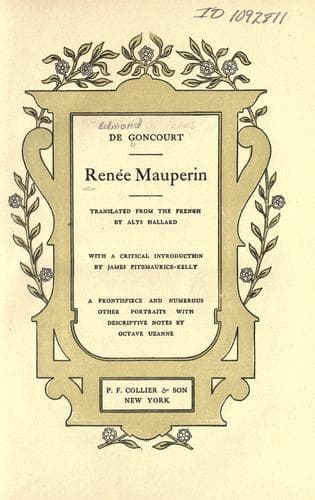
France -- Social life and customs -- 19th century -- Fiction
The eldest of the sons of Charles-Mathias, Louis-Aime de Villacourt, who
served eighteen years and retired from service after the battle of
Malplaquet, died in 1702. His son left Villacourt, settled down in
Paris, threw himself into the life of the capital, and so got rid of the
remainder of a fortune which had already been encroached upon by the
loss of a lawsuit between his father and the d'Haraucourts. He
endeavoured to recover his losses at the gaming-table, got into debt,
and returned to Villacourt with a wife from Carrouge who had kept a
gambling house in Paris. He died in 1752, owning very little besides the
walls of the chateau, and leaving a name less famous and less honourable
than his father's had been. He had two children by his marriage, a
daughter and a son. The daughter became maid of honour to the
Empress-Queen, the son remained at Villacourt, leading a low, coarse
life as a country gentleman. On the abolition of privileges in 1790 he
gave up his rank and lived on a friendly and equal footing with the
peasants until he died in 1792. His son Jean, lieutenant in the regiment
of the Royal-Liegeois in 1787, was in the Nancy affair. He emigrated,
went through the campaigns of 1792 to 1801 in Mirabeau's legion, which
was then commanded by Roger de Damas, and in the Bourbon grenadiers in
Conde's army. On the thirteenth of August, 1796, he was wounded on the
head in the Oberkamlach battle. In 1802 he returned to France, bringing
with him a wife he had married in Germany, who died after bearing him
four children, four sons. He had become weak in intellect, almost
childish in fact, from the result of his wound, and after his wife's
death there was no one to regulate the household expenses. Disorder
gradually crept in, he kept open table and took to drinking, until at
last he was obliged to sell what little land he had round the chateau.
Finally the chateau itself began to crumble away. He could not have it
repaired, as he had no money to pay the workmen. The wind could be felt
through the cracks, and the rain came in. The family were obliged to
give up one room after another, taking refuge where the roof was still
sound. He himself was indifferent to all this; after drinking two or
three glasses of brandy he would take his seat in what used to be the
kitchen garden, on a stone bench near a meridian, the figures of which
had worn away, and there he would get quite cheerful in the sunshine,
calling to people over the hedge to come in and drink with him. Decay
and poverty, however, made rapid strides in the chateau. There was
nothing left of all the old silver but a salad-bowl, which was used for
the food of a horse called Brouska, that the exile had brought with him
from Germany, and which was now allowed to roam in liberty through the
rooms on the ground-floor.
Public-domain text, read in full here on John Shaqi.
Reviews
Reviews
No reviews yet
Be the first to share your thoughts on this work.
Elsewhere in the archive
Join the Discussion
Join the discussion
Sign in to leave a comment or review.
Sign InorCreate an account