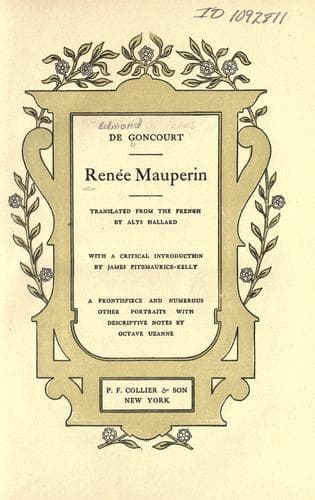
France -- Social life and customs -- 19th century -- Fiction
There were times, however, when Nature asserted itself within her, when
her mind faltered from sheer bodily weakness, and when she listened to
the stealthy progress of the disease which was gradually detaching her
from her hold on life. At such times she would maintain a profound
silence and would be terribly calm, remaining for a long time mute and
motionless almost like a dead person. She would pass half the day in
this way without even hearing the clock strike, gazing before her just
beyond her feet with a steady, fixed gaze and seeing nothing at all. Her
father could not even catch the expression of her eyes at such times.
Her long lashes would quiver two or three times, and she would hide her
eyes by letting the lids droop over them, and it seemed to him then as
though she were asleep with her eyes half open. He would talk to her,
search his brains for something that might interest her, and endeavour
to make jokes, so that she should hear him and feel that he was there;
but in the middle of his sentence his daughter's attention, her
thoughts, and her intelligent look would leave him. He no longer felt
the same warmth in her affection, and when he was with her he himself
felt chilled now. It seemed as if disease were robbing him day by day of
a little more of his daughter's heart.
LIII
Sometimes, too, Renee would let a few words slip, showing that she was
mourning her fate as sick people do, words which sink to the heart and
give one a chill like death itself.
One day her father was reading the newspaper to her; she took it from
him to look at the marriage announcements.
"Twenty-nine! How old she was, wasn't she?" she said, as though speaking
to herself. She had been glancing down the death column. M. Mauperin did
not answer; he paced up and down the room for a few minutes and then
went away.
When Renee was alone she got up to close the door, which her father had
not pulled to, and which kept banging. She fancied she heard a groan in
the corridor and looked, but there was no one there; she listened a
minute; but as everything was silent again she was just going to close
the door, when she thought she heard the same sound again. She went out
into the corridor as far as her father's room. It was from there that it
came. The key was not in the lock, and Renee stooped down and, through
the keyhole, saw her father, who had flung himself on his bed, weeping
bitterly and shaken with sobs. His head was buried in the pillow, and he
was endeavouring to stifle down his tears and his despair.
LIV
Renee was determined that her father should weep no more on her account.
Public-domain text, read in full here on John Shaqi.
Reviews
Reviews
No reviews yet
Be the first to share your thoughts on this work.
Elsewhere in the archive
Join the Discussion
Join the discussion
Sign in to leave a comment or review.
Sign InorCreate an account