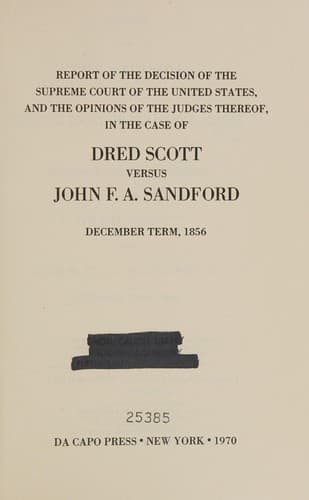
Report of the Decision of the Supreme Court of the United States, and the Opinions of the Judges Thereof, in the Case of Dred Scott versus John F. A. Sandford: December Term, 1856.United States. Supreme Court
History
Report of the Decision of the Supreme Court of the United States, and the Opinions of the Judges Thereof, in the Case of Dred Scott versus John F. A. Sandford: December Term, 1856.
United States. Supreme Court
Scott, Dred, 1809-1858; Slavery -- United States
In conclusion, my opinion is, that the decision of the Circuit Court,
upon the law arising upon the several pleas in bar, is correct, but
that it is erroneous in having sustained the demurrer to the plea in
abatement of the jurisdiction; that for this error the decision of the
Circuit Court should be reversed, and the cause remanded to that
court, with instructions to abate the action, for the reason set forth
and pleaded in the plea in abatement.
In the aforegoing examination of this cause, the circumstance that the
questions involved therein had been previously adjudged between these
parties by the court of the State of Missouri, has not been adverted
to; for although it has been ruled by this court, that in instances of
concurrent jurisdiction, the court first obtaining possession or
cognizance of the controversy should retain and decide it, yet, as in
this case there had been no plea, either of a former judgment or of
_autre action pendent_, it was thought that the fact of a prior
decision, however conclusive it might have been if regularly pleaded,
could not be incidentally taken into view.
* * * * *
Mr. Justice CAMPBELL.
I concur in the judgment pronounced by the Chief Justice, but the
importance of the cause, the expectation and interest it has awakened,
and the responsibility involved in its determination, induce me to
file a separate opinion.
The case shows that the plaintiff, in the year 1834, was a negro slave
in Missouri, the property of Dr. Emerson, a surgeon in the army of the
United States. In 1834, his master took him to the military station at
Rock Island, on the border of Illinois, and in 1836 to Fort Snelling,
in the present Minnesota, then Wisconsin, Territory. While at Fort
Snelling, the plaintiff married a slave who was there with her master,
and two children have been born of this connection; one during the
journey of the family in returning to Missouri, and the other after
their return to that State.
Since 1838, the plaintiff and the members of his family have been in
Missouri in the condition of slaves. The object of this suit is to
establish their freedom. The defendant, who claims the plaintiff and
his family, under the title of Dr. Emerson, denied the jurisdiction of
the Circuit Court, by the plea that the plaintiff was a negro of
African blood, the descendant of Africans who had been imported and
sold in this country as slaves, and thus he had no capacity as a
citizen of Missouri to maintain a suit in the Circuit Court. The court
sustained a demurrer to this plea, a trial was then had upon the
general issue, and special pleas to the effect that the plaintiff and
his family were slaves belonging to the defendant.
Public-domain text, read in full here on John Shaqi.
Reviews
Reviews
No reviews yet
Be the first to share your thoughts on this work.
Elsewhere in the archive
Join the Discussion
Join the discussion
Sign in to leave a comment or review.
Sign InorCreate an account