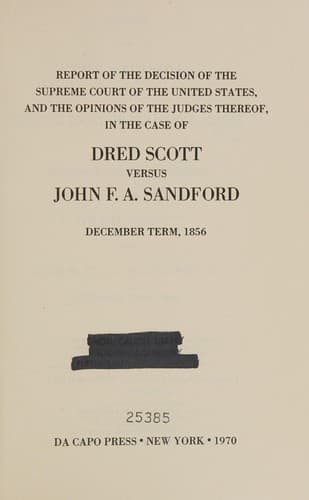
Report of the Decision of the Supreme Court of the United States, and the Opinions of the Judges Thereof, in the Case of Dred Scott versus John F. A. Sandford: December Term, 1856.United States. Supreme Court
History
Report of the Decision of the Supreme Court of the United States, and the Opinions of the Judges Thereof, in the Case of Dred Scott versus John F. A. Sandford: December Term, 1856.
United States. Supreme Court
Scott, Dred, 1809-1858; Slavery -- United States
And the British Parliament did claim a supremacy of legislation
coextensive with the absoluteness of the dominion of the sovereign
over the Crown lands. The American doctrine, to the contrary, is
embodied in two brief resolutions of the people of Pennsylvania, in
1774: 1st. "That the inhabitants of these colonies are entitled to the
same rights and liberties, within the colonies, that the subjects born
in England are entitled within the realm." 2d. "That the power assumed
by Parliament to bind the people of these colonies by statutes, in all
cases whatever, is unconstitutional, and therefore the source of these
unhappy difficulties." The Congress of 1774, in their statement of
rights and grievances, affirm "a free and exclusive power of
legislation" in their several Provincial Legislatures, "in all cases
of taxation and internal polity, subject only to the negative of their
sovereign, in such manner as has been heretofore used and accustomed."
(1 Jour. Cong., 32.)
The unanimous consent of the people of the colonies, then, to the
power of their sovereign, "to dispose of and make all needful rules
and regulations respecting the territory" of the Crown, in 1774, was
deemed by them as entirely consistent with opposition, remonstrance,
the renunciation of allegiance, and proclamation of civil war, in
preference to submission to his claim of supreme power in the
territories.
I pass now to the evidence afforded during the Revolution and
Confederation. The American Revolution was not a social revolution. It
did not alter the domestic condition or capacity of persons within the
colonies, nor was it designed to disturb the domestic relations
existing among them. It was a political revolution, by which thirteen
dependent colonies became thirteen independent States. "The
Declaration of Independence was not," says Justice Chase, "a
declaration that the United Colonies jointly, in a collective
capacity, were independent States, &c., &c., &c., but that each of
them was a sovereign and independent State; that is, that each of them
had a right to govern itself by its own authority and its own laws,
without any control from any other power on earth." (3 Dall., 199; 4
Cr., 212.)
Public-domain text, read in full here on John Shaqi.
Reviews
Reviews
No reviews yet
Be the first to share your thoughts on this work.
Elsewhere in the archive
Join the Discussion
Join the discussion
Sign in to leave a comment or review.
Sign InorCreate an account