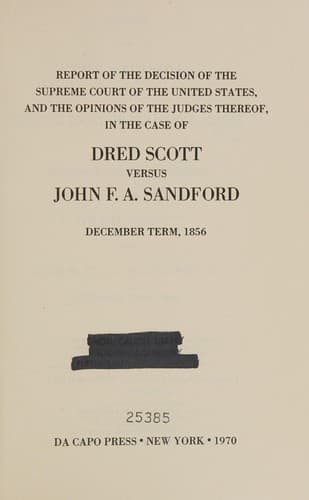
Report of the Decision of the Supreme Court of the United States, and the Opinions of the Judges Thereof, in the Case of Dred Scott versus John F. A. Sandford: December Term, 1856.United States. Supreme Court
History
Report of the Decision of the Supreme Court of the United States, and the Opinions of the Judges Thereof, in the Case of Dred Scott versus John F. A. Sandford: December Term, 1856.
United States. Supreme Court
Scott, Dred, 1809-1858; Slavery -- United States
tendency, and, to an alarming extent, the result, produced by the
agitation arising from it, does not commend it to the patriot or
statesman. This court have determined that the intermigration of
slaves was not committed to the jurisdiction or control of Congress.
Wherever a master is entitled to go within the United States, his
slave may accompany him, without any impediment from, or fear of,
Congressional legislation or interference. The question then arises,
whether Congress, which can exercise no jurisdiction over the
relations of master and slave within the limits of the Union, and is
bound to recognise and respect the rights and relations that validly
exist under the Constitutions and laws of the States, can deny the
exercise of those rights, and prohibit the continuance of those
relations, within the Territories.
And the citation of State statutes prohibiting the immigration of
slaves, and of the decisions of State courts enforcing the forfeiture
of the master's title in accordance with their rule, only darkens the
discussion. For the question is, have Congress the municipal
sovereignty in the Territories which the State Legislatures have
derived from the authority of the people, and exercise in the States?
And this depends upon the construction of the article in the
Constitution before referred to.
And, in my opinion, that clause confers no power upon Congress to
dissolve the relations of the master and slave on the domain of the
United States, either within or without any of the States.
The eighth section of the act of Congress of the 6th of March, 1820,
did not, in my opinion, operate to determine the domestic condition
and _status_ of the plaintiff and his family during their sojourn in
Minnesota Territory, or after their return to Missouri.
The question occurs as to the judgment to be given in this case. It
appeared upon the trial that the plaintiff, in 1834, was in a state of
slavery in Missouri, and he had been in Missouri for near fifteen
years in that condition when this suit was brought. Nor does it appear
that he at any time possessed another state or condition, _de facto_.
His claim to freedom depends upon his temporary elocation, from the
domicil of his origin, in company with his master, to communities
where the law of slavery did not prevail. My examination is confined
to the case, as it was submitted upon uncontested evidence, upon
appropriate issues to the jury, and upon the instructions given and
refused by the court upon that evidence. My opinion is, that the
opinion of the Circuit Court was correct upon all the claims involved
in those issues, and that the verdict of the jury was justified by the
evidence and instructions.
The jury have returned that the plaintiff and his family are slaves.
Public-domain text, read in full here on John Shaqi.
Reviews
Reviews
No reviews yet
Be the first to share your thoughts on this work.
Elsewhere in the archive
Join the Discussion
Join the discussion
Sign in to leave a comment or review.
Sign InorCreate an account