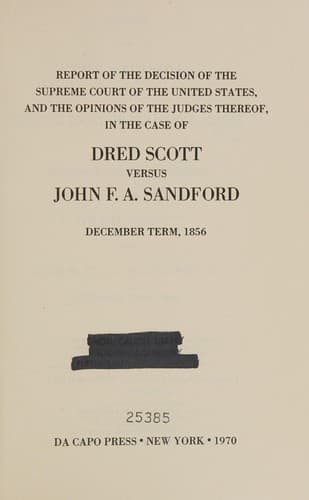
Report of the Decision of the Supreme Court of the United States, and the Opinions of the Judges Thereof, in the Case of Dred Scott versus John F. A. Sandford: December Term, 1856.United States. Supreme Court
History
Report of the Decision of the Supreme Court of the United States, and the Opinions of the Judges Thereof, in the Case of Dred Scott versus John F. A. Sandford: December Term, 1856.
United States. Supreme Court
Scott, Dred, 1809-1858; Slavery -- United States
"The state of slavery is of such a nature that it is incapable of
being introduced on any reasons, moral or political, but only by
positive law, which preserves its force long after the reasons,
occasion, and time itself, from whence it was created, is erased from
the memory; it is of a nature that nothing can be suffered to support
it but positive law."
He referred to the contrary opinion of Lord Hardwicke, in October,
1749, as Chancellor: "That he and Lord Talbot, when Attorney and
Solicitor General, were of opinion that no such claim, as here
presented, for freedom, was valid."
The weight of this decision is sought to be impaired, from the terms
in which it was described by the exuberant imagination of Curran. The
words of Lord Mansfield, in giving the opinion of the court, were such
as were fit to be used by a great judge, in a most important case. It
is a sufficient answer to all objections to that judgment, that it was
pronounced before the Revolution, and that it was considered by this
court as the highest authority. For near a century, the decision in
Somersett's case has remained the law of England. The case of the
slave Grace, decided by Lord Stowell in 1827, does not, as has been
supposed, overrule the judgment of Lord Mansfield. Lord Stowell held
that, during the residence of the slave in England, "No dominion,
authority, or coercion, can be exercised over him." Under another
head, I shall have occasion to examine the opinion in the case of
Grace.
To the position, that slavery can only exist except under the
authority of law, it is objected, that in few if in any instances has
it been established by statutory enactment. This is no answer to the
doctrine laid down by the court. Almost all the principles of the
common law had their foundation in usage. Slavery was introduced into
the colonies of this country by Great Britain at an early period of
their history, and it was protected and cherished, until it became
incorporated into the colonial policy. It is immaterial whether a
system of slavery was introduced by express law, or otherwise, if it
have the authority of law. There is no slave State where the
institution is not recognised and protected by statutory enactments
and judicial decisions. Slaves are made property by the laws of the
slave States, and as such are liable to the claims of creditors; they
descend to heirs, are taxed, and in the South they are a subject of
commerce.
Public-domain text, read in full here on John Shaqi.
Reviews
Reviews
No reviews yet
Be the first to share your thoughts on this work.
Elsewhere in the archive
Join the Discussion
Join the discussion
Sign in to leave a comment or review.
Sign InorCreate an account