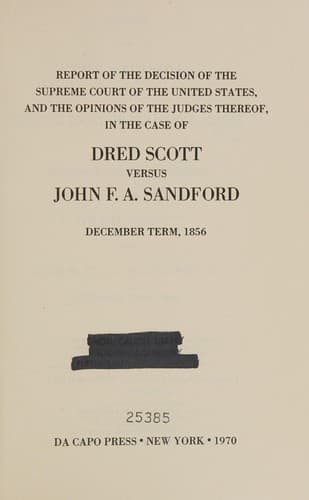
Report of the Decision of the Supreme Court of the United States, and the Opinions of the Judges Thereof, in the Case of Dred Scott versus John F. A. Sandford: December Term, 1856.United States. Supreme Court
History
Report of the Decision of the Supreme Court of the United States, and the Opinions of the Judges Thereof, in the Case of Dred Scott versus John F. A. Sandford: December Term, 1856.
United States. Supreme Court
Scott, Dred, 1809-1858; Slavery -- United States
Many of the States, on the adoption of the Constitution, or shortly
afterward, took measures to abolish slavery within their respective
jurisdictions; and it is a well-known fact that a belief was cherished
by the leading men, South as well as North, that the institution of
slavery would gradually decline, until it would become extinct. The
increased value of slave labor, in the culture of cotton and sugar,
prevented the realization of this expectation. Like all other
communities and States, the South were influenced by what they
considered to be their own interests.
But if we are to turn our attention to the dark ages of the world, why
confine our view to colored slavery? On the same principles, white men
were made slaves. All slavery has its origin in power, and is against
right.
The power of Congress to establish Territorial Governments, and to
prohibit the introduction of slavery therein, is the next point to be
considered.
After the cession of western territory by Virginia and other States,
to the United States, the public attention was directed to the best
mode of disposing of it for the general benefit. While in attendance
on the Federal Convention, Mr. Madison, in a letter to Edmund
Randolph, dated the 22d April, 1787, says: "Congress are deliberating
on the plan most eligible for disposing of the western territory not
yet surveyed. Some alteration will probably be made in the ordinance
on that subject." And in the same letter he says: "The inhabitants of
the Illinois complain of the land jobbers, &c., who are purchasing
titles among them. Those of St. Vincent's complain of the defective
criminal and civil justice among them, as well as of military
protection." And on the next day he writes to Mr. Jefferson: "The
government of the settlements on the Illinois and Wabash is a subject
very perplexing in itself, and rendered more so by our ignorance of
the many circumstances on which a right judgment depends. The
inhabitants at those places claim protection against the savages, and
some provision for both civil and criminal justice."
In May, 1787, Mr. Edmund Randolph submitted to the Federal Convention
certain propositions, as the basis of a Federal Government, among
which was the following:
"_Resolved_, That provision ought to be made for the admission of
States lawfully arising within the limits of the United States,
whether from a voluntary junction of government and territory or
otherwise, with the consent of a number of voices in the National
Legislature less than the whole."
Afterward, Mr. Madison submitted to the Convention, in order to be
referred to the committee of detail, the following powers, as proper
to be added to those of general legislation:
"To dispose of the unappropriated lands of the United States. To
institute temporary Governments for new States arising therein. To
regulate affairs with the Indians, as well within as without the
limits of the United States."
Public-domain text, read in full here on John Shaqi.
Reviews
Reviews
No reviews yet
Be the first to share your thoughts on this work.
Elsewhere in the archive
Join the Discussion
Join the discussion
Sign in to leave a comment or review.
Sign InorCreate an account