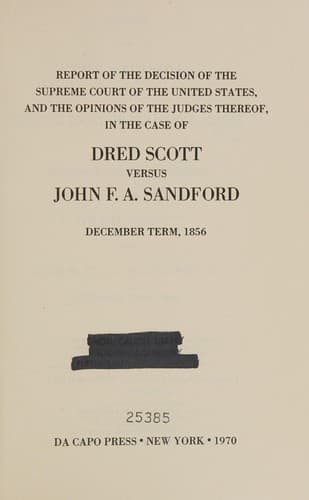
Report of the Decision of the Supreme Court of the United States, and the Opinions of the Judges Thereof, in the Case of Dred Scott versus John F. A. Sandford: December Term, 1856.United States. Supreme Court
History
Report of the Decision of the Supreme Court of the United States, and the Opinions of the Judges Thereof, in the Case of Dred Scott versus John F. A. Sandford: December Term, 1856.
United States. Supreme Court
Scott, Dred, 1809-1858; Slavery -- United States
It is clear that the ordinance did not go into operation by virtue of
the authority of the Confederation, but by reason of its modification
and adoption by Congress under the Constitution. It seems to be
supposed, in the opinion of the court, that the articles of cession
placed it on a different footing from territories subsequently
acquired. I am unable to perceive the force of this distinction. That
the ordinance was intended for the government of the Northwestern
Territory, and was limited to such Territory, is admitted. It was
extended to Southern Territories, with modifications, by acts of
Congress, and to some Northern Territories. But the ordinance was made
valid by the act of Congress, and without such act could have been of
no force. It rested for its validity on the act of Congress, the same,
in my opinion, as the Missouri compromise line.
If Congress may establish a Territorial Government in the exercise of
its discretion, it is a clear principle that a court cannot control
that discretion. This being the case, I do not see on what ground the
act is held to be void. It did not purport to forfeit property, or
take it for public purposes. It only prohibited slavery; in doing
which, it followed the ordinance of 1787.
I will now consider the fourth head, which is: "The effect of taking
slaves into a State or Territory, and so holding them, where slavery
is prohibited."
If the principle laid down in the case of Prigg _v._ The State of
Pennsylvania is to be maintained, and it is certainly to be maintained
until overruled, as the law of this court, there can be no difficulty
on this point. In that case, the court says: "The state of slavery is
deemed to be a mere municipal regulation, founded upon and limited to
the range of the territorial laws." If this be so, slavery can exist
nowhere except under the authority of law, founded on usage having the
force of law, or by statutory recognition. And the court further says:
"It is manifest, from this consideration, that if the Constitution had
not contained the clause requiring the rendition of fugitives from
labor, every non-slaveholding State in the Union would have been at
liberty to have declared free all runaway slaves coming within its
limits, and to have given them entire immunity and protection against
the claims of their masters."
Public-domain text, read in full here on John Shaqi.
Reviews
Reviews
No reviews yet
Be the first to share your thoughts on this work.
Elsewhere in the archive
Join the Discussion
Join the discussion
Sign in to leave a comment or review.
Sign InorCreate an account