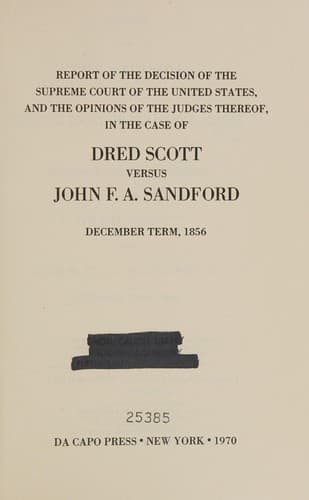
Report of the Decision of the Supreme Court of the United States, and the Opinions of the Judges Thereof, in the Case of Dred Scott versus John F. A. Sandford: December Term, 1856.United States. Supreme Court
History
Report of the Decision of the Supreme Court of the United States, and the Opinions of the Judges Thereof, in the Case of Dred Scott versus John F. A. Sandford: December Term, 1856.
United States. Supreme Court
Scott, Dred, 1809-1858; Slavery -- United States
When, therefore, as in this case, the necessary averments as to
citizenship are made on the record, and jurisdiction is assumed to
exist, and the defendant comes by a plea to the jurisdiction to
displace that presumption, he occupies, in my judgment, precisely the
position described in Bacon Ab., Abatement: "Abatement, in the general
acceptation of the word, signifies a plea, put in by the defendant, in
which he shows cause to the court why he should not be impleaded; or,
if at all, not in the manner and form he now is."
This being, then, a plea in abatement, to the jurisdiction of the
court, I must judge of its sufficiency by those rules of the common
law applicable to such pleas.
The plea was as follows: "And the said John F.A. Sandford, in his own
proper person, comes and says that this court ought not to have or
take further cognizance of the action aforesaid, because he says that
said cause of action, and each and every of them, (if any such have
accrued to the said Dred Scott,) accrued to the said Dred Scott out of
the jurisdiction of this court, and exclusively within the
jurisdiction of the courts of the State of Missouri; for that, to wit,
the said plaintiff, Dred Scott, is not a citizen of the State of
Missouri, as alleged in his declaration, because he is a negro of
African descent; his ancestors were of pure African blood, and were
brought into this country and sold as negro slaves, and this the said
Sandford is ready to verify. Wherefore, he prays judgment whether this
court can or will take further cognizance of the action aforesaid."
The plaintiff demurred, and the judgment of the Circuit Court was,
that the plea was insufficient.
I cannot treat this plea as a general traverse of the citizenship
alleged by the plaintiff. Indeed, if it were so treated, the plea was
clearly bad, for it concludes with a verification, and not to the
country, as a general traverse should. And though this defect in a
plea in bar must be pointed out by a special demurrer, it is never
necessary to demur specially to a plea in abatement; all matters,
though of form only, may be taken advantage of upon a general demurrer
to such a plea. (Chitty on Pl., 465.)
Public-domain text, read in full here on John Shaqi.
Reviews
Reviews
No reviews yet
Be the first to share your thoughts on this work.
Elsewhere in the archive
Join the Discussion
Join the discussion
Sign in to leave a comment or review.
Sign InorCreate an account