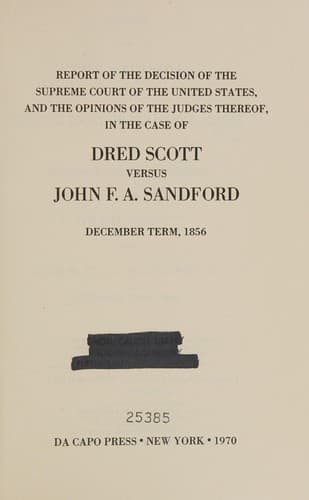
Report of the Decision of the Supreme Court of the United States, and the Opinions of the Judges Thereof, in the Case of Dred Scott versus John F. A. Sandford: December Term, 1856.United States. Supreme Court
History
Report of the Decision of the Supreme Court of the United States, and the Opinions of the Judges Thereof, in the Case of Dred Scott versus John F. A. Sandford: December Term, 1856.
United States. Supreme Court
Scott, Dred, 1809-1858; Slavery -- United States
It is a substantive power, distinct in its nature from all others;
capable of affecting not only the relations of the States to the
General Government, but of controlling the political condition of the
people of the United States. Certainly we ought to find this power
granted by the Constitution, at least by some necessary inference,
before we can say it does not remain to the States or the people. I
proceed therefore to examine all the provisions of the Constitution
which may have some bearing on this subject.
Among the powers expressly granted to Congress is "the power to
establish a uniform rule of naturalization." It is not doubted that
this is a power to prescribe a rule for the removal of the
disabilities consequent on foreign birth. To hold that it extends
further than this, would do violence to the meaning of the term
naturalization, fixed in the common law, (Co. Lit., 8 a, 129 a; 2
Ves., sen., 286; 2 Bl. Com., 293,) and in the minds of those who
concurred in framing and adopting the Constitution. It was in this
sense of conferring on an alien and his issue the rights and powers of
a native-born citizen, that it was employed in the Declaration of
Independence. It was in this sense it was expounded in the Federalist,
(No. 42,) has been understood by Congress, by the Judiciary, (2
Wheat., 259, 269; 3 Wash. R., 313, 322; 12 Wheat., 277,) and by
commentators on the Constitution. (3 Story's Com. on Con., 1-3; 1
Rawle on Con., 84-88; 1 Tucker's Bl. Com. App., 255-259.)
It appears, then, that the only power expressly granted to Congress to
legislate concerning citizenship, is confined to the removal of the
disabilities of foreign birth.
Whether there be anything in the Constitution from which a broader
power may be implied, will best be seen when we come to examine the
two other alternatives, which are, whether all free persons, born on
the soil of the several States, or only such of them as may be
citizens of each State, respectively, are thereby citizens of the
United States. The last of these alternatives, in my judgment,
contains the truth.
Undoubtedly, as has already been said, it is a principle of public
law, recognised by the Constitution itself, that birth on the soil of
a country both creates the duties and confers the rights of
citizenship. But it must be remembered, that though the Constitution
was to form a Government, and under it the United States of America
were to be one united sovereign nation, to which loyalty and obedience
on the one side, and from which protection and privileges on the
other, would be due, yet the several sovereign States, whose people
were then citizens, were not only to continue in existence, but with
powers unimpaired, except so far as they were granted by the people to
the National Government.
Public-domain text, read in full here on John Shaqi.
Reviews
Reviews
No reviews yet
Be the first to share your thoughts on this work.
Elsewhere in the archive
Join the Discussion
Join the discussion
Sign in to leave a comment or review.
Sign InorCreate an account