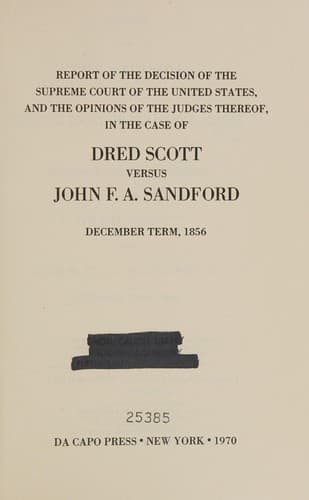
Report of the Decision of the Supreme Court of the United States, and the Opinions of the Judges Thereof, in the Case of Dred Scott versus John F. A. Sandford: December Term, 1856.United States. Supreme Court
History
Report of the Decision of the Supreme Court of the United States, and the Opinions of the Judges Thereof, in the Case of Dred Scott versus John F. A. Sandford: December Term, 1856.
United States. Supreme Court
Scott, Dred, 1809-1858; Slavery -- United States
"The citizens of each State shall be entitled to all the privileges
and immunities of citizens of the several States." Nowhere else in the
Constitution is there anything concerning a general citizenship; but
here, privileges and immunities to be enjoyed throughout the United
States, under and by force of the national compact, are granted and
secured. In selecting those who are to enjoy these national rights of
citizenship, how are they described? As citizens of each State. It is
to them these national rights are secured. The qualification for them
is not to be looked for in any provision of the Constitution or laws
of the United States. They are to be citizens of the several States,
and, as such, the privileges and immunities of general citizenship,
derived from and guarantied by the Constitution, are to be enjoyed by
them. It would seem that if it had been intended to constitute a class
of native-born persons within the States, who should derive their
citizenship of the United States from the action of the Federal
Government, this was an occasion for referring to them. It cannot be
supposed that it was the purpose of this article to confer the
privileges and immunities of citizens in all the States upon persons
not citizens of the United States.
And if it was intended to secure these rights only to citizens of the
United States, how has the Constitution here described such persons?
Simply as citizens of each State.
But, further: though, as I shall presently more fully state, I do not
think the enjoyment of the elective franchise essential to
citizenship, there can be no doubt it is one of the chiefest
attributes of citizenship under the American Constitutions; and the
just and constitutional possession of this right is decisive evidence
of citizenship. The provisions made by a Constitution on this subject
must therefore be looked to as bearing directly on the question what
persons are citizens under that Constitution; and as being decisive,
to this extent, that all such persons as are allowed by the
Constitution to exercise the elective franchise, and thus to
participate in the Government of the United States, must be deemed
citizens of the United States.
Here, again, the consideration presses itself upon us, that if there
was designed to be a particular class of native-born persons within
the States, deriving their citizenship from the Constitution and laws
of the United States, they should at least have been referred to as
those by whom the President and House of Representatives were to be
elected, and to whom they should be responsible.
Instead of that, we again find this subject referred to the laws of
the several States. The electors of President are to be appointed in
such manner as the Legislature of each State may direct, and the
qualifications of electors of members of the House of Representatives
shall be the same as for electors of the most numerous branch of the
State Legislature.
Public-domain text, read in full here on John Shaqi.
Reviews
Reviews
No reviews yet
Be the first to share your thoughts on this work.
Elsewhere in the archive
Join the Discussion
Join the discussion
Sign in to leave a comment or review.
Sign InorCreate an account