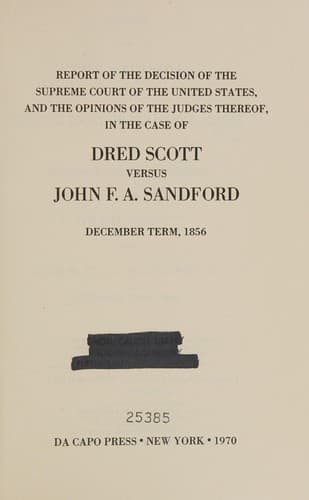
Report of the Decision of the Supreme Court of the United States, and the Opinions of the Judges Thereof, in the Case of Dred Scott versus John F. A. Sandford: December Term, 1856.United States. Supreme Court
History
Report of the Decision of the Supreme Court of the United States, and the Opinions of the Judges Thereof, in the Case of Dred Scott versus John F. A. Sandford: December Term, 1856.
United States. Supreme Court
Scott, Dred, 1809-1858; Slavery -- United States
I say the law of Missouri, because a judicial tribunal, in one State
or nation, can recognise personal rights acquired by force of the law
of any other State or nation, only so far as it is the law of the
former State that those rights should be recognised. But, in the
absence of positive law to the contrary, the will of every civilized
State must be presumed to be to allow such effect to foreign laws as
is in accordance with the settled rules of international law. And
legal tribunals are bound to act on this presumption. It may be
assumed that the motive of the State in allowing such operation to
foreign laws is what has been termed comity. But, as has justly been
said, (per Chief Justice Taney, 13 Pet., 589,) it is the comity of the
State, not of the court. The judges have nothing to do with the motive
of the State. Their duty is simply to ascertain and give effect to its
will. And when it is found by them that its will to depart from a rule
of international law has not been manifested by the State, they are
bound to assume that its will is to give effect to it. Undoubtedly,
every sovereign State may refuse to recognise a change, wrought by the
law of a foreign State, on the _status_ of a person, while within such
foreign State, even in cases where the rules of international law
require that recognition. Its will to refuse such recognition may be
manifested by what we term statute law, or by the customary law of the
State. It is within the province of its judicial tribunals to inquire
and adjudge whether it appears, from the statute or customary law of
the State, to be the will of the State to refuse to recognise such
changes of _status_ by force of foreign law, as the rules of the law
of nations require to be recognised. But, in my opinion, it is not
within the province of any judicial tribunal to refuse such
recognition from any political considerations, or any view it may take
of the exterior political relations between the State and one or more
foreign States, or any impressions it may have that a change of
foreign opinion and action on the subject of slavery may afford a
reason why the State should change its own action. To understand and
give just effect to such considerations, and to change the action of
the State in consequence of them, are functions of diplomatists and
legislators, not of judges.
The inquiry to be made on this part of the case is, therefore, whether
the State of Missouri has, by its statute, or its customary law,
manifested its will to displace any rule of international law,
applicable to a change of the _status_ of a slave, by foreign law.
I have not heard it suggested that there was any statute of the State
of Missouri bearing on this question. The customary law of Missouri is
the common law, introduced by statute in 1816. (1 Ter. Laws, 436.) And
the common law, as Blackstone says, (4 Com., 67,) adopts, in its full
extent, the law of nations, and holds it to be a part of the law of
the land.
Public-domain text, read in full here on John Shaqi.
Reviews
Reviews
No reviews yet
Be the first to share your thoughts on this work.
Elsewhere in the archive
Join the Discussion
Join the discussion
Sign in to leave a comment or review.
Sign InorCreate an account