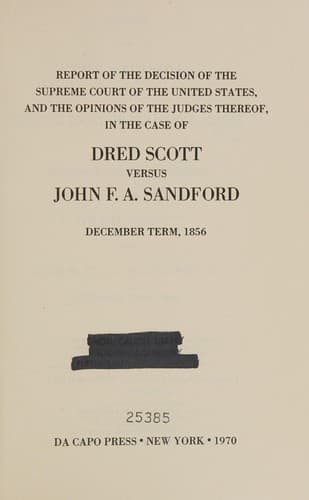
Report of the Decision of the Supreme Court of the United States, and the Opinions of the Judges Thereof, in the Case of Dred Scott versus John F. A. Sandford: December Term, 1856.United States. Supreme Court
History
Report of the Decision of the Supreme Court of the United States, and the Opinions of the Judges Thereof, in the Case of Dred Scott versus John F. A. Sandford: December Term, 1856.
United States. Supreme Court
Scott, Dred, 1809-1858; Slavery -- United States
The court instructed the jury that, "upon the facts in this case, the
law is with the defendant." This withdrew from the jury the
consideration and decision of every matter of fact. The evidence in
the case consisted of written admissions, signed by the counsel of the
parties. If the case had been submitted to the judgment of the court,
upon an agreed statement of facts, entered of record, in place of a
special verdict, it would have been necessary for the court below, and
for this court, to pronounce its judgment solely on those facts, thus
agreed, without inferring any other facts therefrom. By the rules of
the common law applicable to such a case, and by force of the seventh
article of the amendments of the Constitution, this court is precluded
from finding any fact not agreed to by the parties on the record. No
submission to the court on a statement of facts was made. It was a
trial by jury, in which certain admissions, made by the parties, were
the evidence. The jury were not only competent, but were bound to draw
from that evidence every inference which, in their judgment, exercised
according to the rules of law, it would warrant. The Circuit Court
took from the jury the power to draw any inferences from the
admissions made by the parties, and decided the case for the
defendant. This course can be justified here, if at all, only by its
appearing that upon the facts agreed, and all such inferences of fact
favorable to the plaintiff's case, as the jury might have been
warranted in drawing from those admissions, the law was with the
defendant. Otherwise, the plaintiff would be deprived of the benefit
of his trial by jury, by whom, for aught we can know, those inferences
favorable to his case would have been drawn.
The material facts agreed, bearing on this part of the case, are, that
Dr. Emerson, the plaintiff's master, resided about two years at the
military post of Fort Snelling, being a surgeon in the army of the
United States, his domicil of origin being unknown; and what, if
anything, he had done, to preserve or change his domicil prior to his
residence at Rock Island, being also unknown.
Public-domain text, read in full here on John Shaqi.
Reviews
Reviews
No reviews yet
Be the first to share your thoughts on this work.
Elsewhere in the archive
Join the Discussion
Join the discussion
Sign in to leave a comment or review.
Sign InorCreate an account