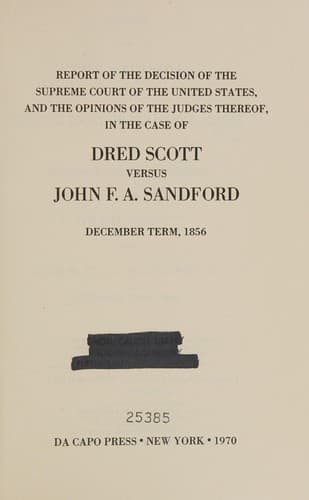
Report of the Decision of the Supreme Court of the United States, and the Opinions of the Judges Thereof, in the Case of Dred Scott versus John F. A. Sandford: December Term, 1856.United States. Supreme Court
History
Report of the Decision of the Supreme Court of the United States, and the Opinions of the Judges Thereof, in the Case of Dred Scott versus John F. A. Sandford: December Term, 1856.
United States. Supreme Court
Scott, Dred, 1809-1858; Slavery -- United States
On the 29th of August, (5 Elliot, 492,) the report of the committee
was taken up, and after debate, which exhibited great diversity of
views concerning the proper mode of providing for the subject, arising
out of the supposed diversity of interests of the large and small
States, and between those which had and those which had not unsettled
territory, but no difference of opinion respecting the propriety and
necessity of some adequate provision for the subject, Gouverneur
Morris moved the clause as it stands in the Constitution. This met
with general approbation, and was at once adopted. The whole section
is as follows:
"New States may be admitted by the Congress into this Union; but no
new State shall be formed or erected within the jurisdiction of any
other State, nor any State be formed by the junction of two or more
States, or parts of States, without the consent of the Legislatures of
the States concerned, as well as of Congress.
"The Congress shall have power to dispose of and make all needful
rules and regulations respecting the territory or other property
belonging to the United States; and nothing in this Constitution shall
be so construed as to prejudice any claims of the United States or any
particular State."
That Congress has some power to institute temporary Governments over
the territory, I believe all agree; and, if it be admitted that the
necessity of some power to govern the territory of the United States
could not and did not escape the attention of the Convention and the
people, and that the necessity is so great, that, in the absence of
any express grant, it is strong enough to raise an implication of the
existence of that power, it would seem to follow that it is also
strong enough to afford material aid in construing an express grant of
power respecting that territory; and that they who maintain the
existence of the power, without finding any words at all in which it
is conveyed, should be willing to receive a reasonable interpretation
of language of the Constitution, manifestly intended to relate to the
territory, and to convey to Congress some authority concerning it.
It would seem, also, that when we find the subject-matter of the
growth and formation and admission of new States, and the disposal of
the territory for these ends, were under consideration, and that some
provision therefor was expressly made, it is improbable that it would
be, in its terms, a grossly inadequate provision; and that an
indispensably necessary power to institute temporary Governments, and
to legislate for the inhabitants of the territory, was passed silently
by, and left to be deduced from the necessity of the case.
In the argument at the bar, great attention has been paid to the
meaning of the word "territory."
Public-domain text, read in full here on John Shaqi.
Reviews
Reviews
No reviews yet
Be the first to share your thoughts on this work.
Elsewhere in the archive
Join the Discussion
Join the discussion
Sign in to leave a comment or review.
Sign InorCreate an account