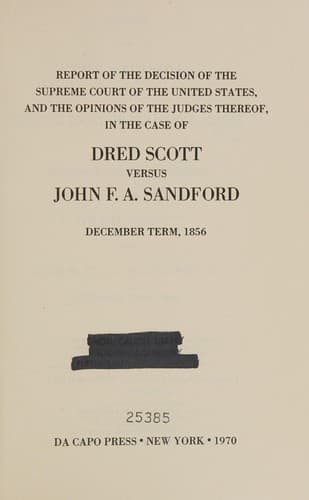
Report of the Decision of the Supreme Court of the United States, and the Opinions of the Judges Thereof, in the Case of Dred Scott versus John F. A. Sandford: December Term, 1856.United States. Supreme Court
History
Report of the Decision of the Supreme Court of the United States, and the Opinions of the Judges Thereof, in the Case of Dred Scott versus John F. A. Sandford: December Term, 1856.
United States. Supreme Court
Scott, Dred, 1809-1858; Slavery -- United States
In this view, I proceed briefly to examine the practical construction
placed on the clause now in question, so far as it respects the
inclusion therein of power to permit or prohibit slavery in the
Territories.
It has already been stated, that after the Government of the United
States was organized under the Constitution, the temporary Government
of the Territory northwest of the river Ohio could no longer exist,
save under the powers conferred on Congress by the Constitution.
Whatever legislative, judicial, or executive authority should be
exercised therein could be derived only from the people of the United
States under the Constitution. And, accordingly, an act was passed on
the 7th day of August, 1789, (1 Stat. at Large, 50,) which recites:
"Whereas, in order that the ordinance of the United States in Congress
assembled, for the government of the territory northwest of the river
Ohio, _may continue to have full effect_, it is required that certain
provisions should be made, so as to adapt the same to the present
Constitution of the United States." It then provides for the
appointment by the President of all officers, who, by force of the
ordinance, were to have been appointed by the Congress of the
Confederation, and their commission in the manner required by the
Constitution; and empowers the Secretary of the Territory to exercise
the powers of the Governor in case of the death or necessary absence
of the latter.
Here is an explicit declaration of the will of the first Congress, of
which fourteen members, including Mr. Madison, had been members of the
Convention which framed the Constitution, that the ordinance, one
article of which prohibited slavery, "should continue to have full
effect." Gen. Washington, who signed this bill, as President, was the
President of that Convention.
It does not appear to me to be important, in this connection, that
that clause in the ordinance which prohibited slavery was one of a
series of articles of what is therein termed a compact. The Congress
of the Confederation had no power to make such a compact, nor to act
at all on the subject; and after what had been so recently said by Mr.
Madison on this subject, in the thirty-eighth number of the
_Federalist_, I cannot suppose that he, or any others who voted for
this bill, attributed any intrinsic effect to what was denominated in
the ordinance a compact between "the original States and the people
and States in the new territory;" there being no new States then in
existence in the territory, with whom a compact could be made, and the
few scattered inhabitants, unorganized into a political body, not
being capable of becoming a party to a treaty, even if the Congress of
the Confederation had had power to make one touching the government of
that territory.
Public-domain text, read in full here on John Shaqi.
Reviews
Reviews
No reviews yet
Be the first to share your thoughts on this work.
Elsewhere in the archive
Join the Discussion
Join the discussion
Sign in to leave a comment or review.
Sign InorCreate an account