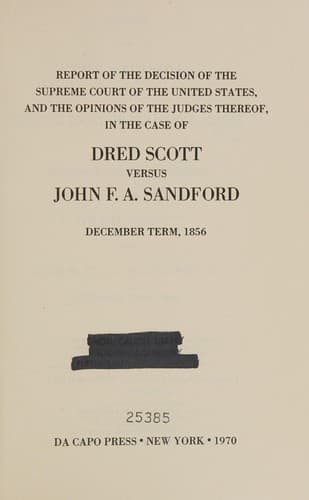
Report of the Decision of the Supreme Court of the United States, and the Opinions of the Judges Thereof, in the Case of Dred Scott versus John F. A. Sandford: December Term, 1856.United States. Supreme Court
History
Report of the Decision of the Supreme Court of the United States, and the Opinions of the Judges Thereof, in the Case of Dred Scott versus John F. A. Sandford: December Term, 1856.
United States. Supreme Court
Scott, Dred, 1809-1858; Slavery -- United States
It may with truth be affirmed, that since the establishment of the
several communities now constituting the States of this Confederacy,
there never has been submitted to any tribunal within its limits
questions surpassing in importance those now claiming the
consideration of this court. Indeed it is difficult to imagine, in
connection with the systems of polity peculiar to the United States, a
conjuncture of graver import than that must be, within which it is
aimed to comprise, and to control, not only the faculties and
practical operation appropriate to the American Confederacy as such,
but also the rights and powers of its separate and independent
members, with reference alike to their internal and domestic authority
and interests, and the relations they sustain to their confederates.
To my mind it is evident, that nothing less than the ambitious and
far-reaching pretension to compass these objects of vital concern, is
either directly essayed or necessarily implied in the positions
attempted in the argument for the plaintiff in error.
How far these positions have any foundation in the nature of the
rights and relations of separate, equal, and independent Governments,
or in the provisions of our own Federal compact, or the laws enacted
under and in pursuance of the authority of that compact, will be
presently investigated.
In order correctly to comprehend the tendency and force of those
positions, it is proper here succinctly to advert to the facts upon
which the questions of law propounded in the argument have arisen.
This was an action of trespass _vi et armis_, instituted in the
Circuit Court of the United States for the district of Missouri, in
the name of the plaintiff in error, _a negro_ held as a slave, for the
recovery of freedom for himself, his wife, and two children, _also
negroes_.
To the declaration in this case the defendant below, who is also the
defendant in error, pleaded in abatement that the court could not take
cognizance of the cause, because the plaintiff was not _a citizen_ of
the State of Missouri, as averred in the declaration, but was a _negro
of African descent_, and that his ancestors were of pure African
blood, and were brought into this country and sold as _negro slaves_;
and hence it followed, from the second section of the third article of
the Constitution, which creates the judicial power of the United
States, with respect to controversies between citizens of different
States, that the Circuit Court could not take cognizance of the
action.
Public-domain text, read in full here on John Shaqi.
Reviews
Reviews
No reviews yet
Be the first to share your thoughts on this work.
Join the Discussion
Join the discussion
Sign in to leave a comment or review.
Sign InorCreate an account