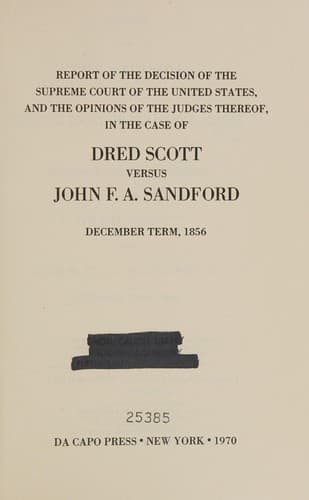
Report of the Decision of the Supreme Court of the United States, and the Opinions of the Judges Thereof, in the Case of Dred Scott versus John F. A. Sandford: December Term, 1856.United States. Supreme Court
History
Report of the Decision of the Supreme Court of the United States, and the Opinions of the Judges Thereof, in the Case of Dred Scott versus John F. A. Sandford: December Term, 1856.
United States. Supreme Court
Scott, Dred, 1809-1858; Slavery -- United States
On behalf of the plaintiff it has been urged, that by the pleas
interposed in bar of a recovery in the court below, (which pleas both
in fact and in law are essentially the same with the objections
averred in abatement,) the defence in abatement has been displaced or
waived; that it could therefore no longer be relied on in the Circuit
Court, and cannot claim the consideration of this court in reviewing
this cause. This position is regarded as wholly untenable. On the
contrary, it would seem to follow conclusively from the peculiar
character of the courts of the United States, as organized under the
Constitution and the statutes, and as defined by numerous and
unvarying adjudications from this bench, that there is not one of
those courts whose jurisdiction and powers can be deduced from mere
custom or tradition; not one, whose jurisdiction and powers must not
be traced palpably to, and invested exclusively by, the Constitution
and statutes of the United States; not one that is not bound,
therefore, at all times, and at all stages of its proceedings, to look
to and to regard the special and declared extent and bounds of its
commission and authority. There is no such tribunal of the United
States as a court of _general jurisdiction_, in the sense in which
that phrase is applied to the superior courts under the common law;
and even with respect to the courts existing under that system, it is
a well-settled principle, that _consent_ can never give jurisdiction.
The principles above stated, and the consequences regularly deducible
from them, have, as already remarked, been repeatedly and unvaryingly
propounded from this bench. Beginning with the earliest decisions of
this court, we have the cases of Bingham _v._ Cabot et al., (3 Dallas,
382;) Turner _v._ Eurille, (4 Dallas, 7;) Abercrombie _v._ Dupuis et
al., (1 Cranch, 343;) Wood _v._ Wagnon, (2 Cranch, 9;) The United
States _v._ The brig Union et al., (4 Cranch, 216;) Sullivan _v._ The
Fulton Steamboat Company, (6 Wheaton, 450;) Mollan et al. _v._
Torrence, (9 Wheaton, 537;) Brown _v._ Keene, (8 Peters, 112,) and
Jackson _v._ Ashton, (8 Peters, 148;) ruling, in uniform and unbroken
current, the doctrine that it is essential to the jurisdiction of the
courts of the United States, that the facts upon which it is founded
should appear upon the record. Nay, to such an extent and so
inflexibly has this requisite to the jurisdiction been enforced, that
in the case of Capron _v._ Van Noorden, (2 Cranch, 126,) it is
declared, that the plaintiff in this court may assign for error his
own omission in the pleadings in the court below, where they go to the
jurisdiction. This doctrine has been, if possible, more strikingly
illustrated in a later decision, the case of The State of Rhode Island
_v._ The State of Massachusetts, in the 12th of Peters.
Public-domain text, read in full here on John Shaqi.
Reviews
Reviews
No reviews yet
Be the first to share your thoughts on this work.
Join the Discussion
Join the discussion
Sign in to leave a comment or review.
Sign InorCreate an account