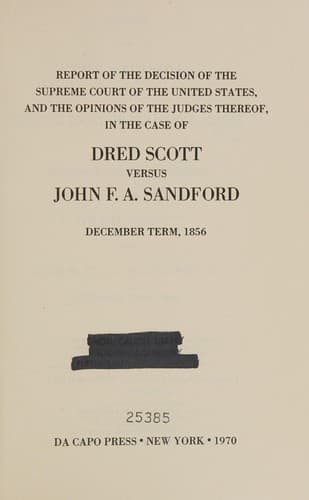
Report of the Decision of the Supreme Court of the United States, and the Opinions of the Judges Thereof, in the Case of Dred Scott versus John F. A. Sandford: December Term, 1856.United States. Supreme Court
History
Report of the Decision of the Supreme Court of the United States, and the Opinions of the Judges Thereof, in the Case of Dred Scott versus John F. A. Sandford: December Term, 1856.
United States. Supreme Court
Scott, Dred, 1809-1858; Slavery -- United States
In this case, on page 718 of the volume, this court, with reference to
a motion to dismiss the cause _for want of jurisdiction_, have said:
"_However late this objection has been made, or may be made, in any
cause in an inferior or appellate court of the United States_, it must
be considered and decided before any court can move one farther step
in the cause, as any movement is necessarily to exercise the
jurisdiction. Jurisdiction is the power to hear and determine the
subject-matter in controversy between the parties to a suit; to
adjudicate or exercise any judicial power over them. The question is,
whether on the case before the court their action is judicial or
extra-judicial; with or without the authority of law to render a
judgment or decree upon the rights of the litigant parties. A motion
to dismiss a cause pending in the courts of the United States, is not
analogous to a plea to the jurisdiction of a court of common law or
equity in England; there, the superior courts have a general
jurisdiction over all persons within the realm, and all causes of
action between them. It depends on the subject-matter, whether the
jurisdiction shall be exercised by a court of law or equity; but that
court to which it appropriately belongs can act judicially upon the
party and the subject of the suit, unless it shall be made apparent to
the court that the judicial determination of the case has been
withdrawn from the court of general jurisdiction to an inferior and
limited one. It is a necessary presumption that the court of general
jurisdiction can act upon the given case, when nothing to the
contrary appears; hence has arisen the rule that the party claiming an
exemption from its process must set out the reason by a special plea
in abatement, and show that some inferior court of law or equity has
the exclusive cognizance of the case, otherwise the superior court
must proceed in virtue of its general jurisdiction. A motion to
dismiss, therefore, cannot be entertained, as it does not disclose a
case of exception; and if a plea in abatement is put in, it must not
only make out the exception, but point to the particular court to
which the case belongs. There are other classes of cases where the
objection to the jurisdiction is of a different nature, as on a bill
in chancery, that the subject-matter is cognizable only by the King in
Council, or that the parties defendant cannot be brought before any
municipal court on account of their sovereign character or the nature
of the controversy; or to the very common cases which present the
question, whether the cause belong to a court of law or equity. To
such cases, a plea in abatement would not be applicable, because the
plaintiff could not sue in an inferior court. The objection goes to a
denial of any jurisdiction of a municipal court in the one class of
cases, and to the jurisdiction of any court of equity or of law in the
other, on which last the court decides according to its discretion.
Public-domain text, read in full here on John Shaqi.
Reviews
Reviews
No reviews yet
Be the first to share your thoughts on this work.
Join the Discussion
Join the discussion
Sign in to leave a comment or review.
Sign InorCreate an account