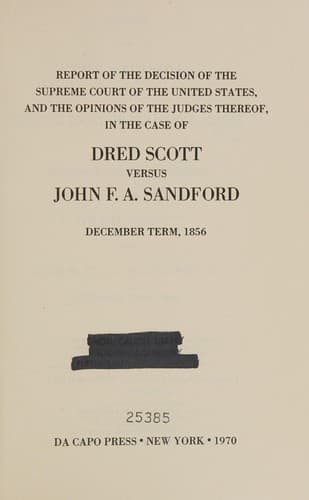
Report of the Decision of the Supreme Court of the United States, and the Opinions of the Judges Thereof, in the Case of Dred Scott versus John F. A. Sandford: December Term, 1856.United States. Supreme Court
History
Report of the Decision of the Supreme Court of the United States, and the Opinions of the Judges Thereof, in the Case of Dred Scott versus John F. A. Sandford: December Term, 1856.
United States. Supreme Court
Scott, Dred, 1809-1858; Slavery -- United States
"An objection to jurisdiction on the ground of exemption from the
process of the court in which the suit is brought, or the manner in
which a defendant is brought into it, is waived by appearance and
pleading to issue; but when the objection goes to the power of the
court over the parties or the subject-matter, the defendant need not,
for he cannot, give the plaintiff a better writ. Where an inferior
court can have no jurisdiction of a case of law or equity, the ground
of objection is not taken by plea in abatement, as an exception of the
given case from the otherwise general jurisdiction of the court;
appearance does not cure the defect of judicial power, and it may be
relied on by plea, answer, demurrer, _or at the trial or hearing_. As
a denial of jurisdiction over the subject-matter of a suit between
parties within the realm, over which and whom the court has power to
act, cannot be successful in an English court of general jurisdiction,
a motion like the present could not be sustained consistently with the
principles of its constitution. _But as this court is one of limited
and special original jurisdiction_, its action must be confined to the
particular cases, controversies, and parties, over which the
Constitution and laws have authorized it to act; any proceeding
without the limits prescribed is _coram non judice_, and its action a
nullity. And whether the want or excess of power is objected by a
party, or is apparent to the court, it must surcease its action or
proceed extra-judicially."
In the constructing of pleadings either in abatement or in bar, every
fact or position constituting a portion of the public law, or of known
or general history, is necessarily implied. Such fact or position need
not be specially averred and set forth; it is what the world at large
and every individual are presumed to know--nay, are bound to know and
to be governed by.
If, on the other hand, there exist facts or circumstances by which a
particular case would be withdrawn or exempted from the influence of
public law or necessary historical knowledge, such facts and
circumstances form an exception to the general principle, and these
must be specially set forth and _established_ by those who would avail
themselves of such exception.
Public-domain text, read in full here on John Shaqi.
Reviews
Reviews
No reviews yet
Be the first to share your thoughts on this work.
Join the Discussion
Join the discussion
Sign in to leave a comment or review.
Sign InorCreate an account