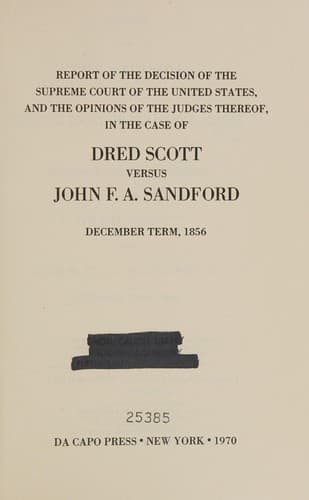
Report of the Decision of the Supreme Court of the United States, and the Opinions of the Judges Thereof, in the Case of Dred Scott versus John F. A. Sandford: December Term, 1856.United States. Supreme Court
History
Report of the Decision of the Supreme Court of the United States, and the Opinions of the Judges Thereof, in the Case of Dred Scott versus John F. A. Sandford: December Term, 1856.
United States. Supreme Court
Scott, Dred, 1809-1858; Slavery -- United States
It may be assumed as a postulate, that to a slave, as such, there
appertains and can appertain no relation, civil or political, with the
State or the Government. He is himself strictly _property_, to be used
in subserviency to the interests, the convenience, or the will, of
his owner; and to suppose, with respect to the former, the existence
of any privilege or discretion, or of any obligation to others
incompatible with the magisterial rights just defined, would be by
implication, if not directly, to deny the relation of master and
slave, since none can possess and enjoy, as his own, that which
another has a paramount right and power to withhold. Hence it follows,
necessarily, that a slave, the _peculium_ or property of a master, and
possessing within himself no civil nor political rights or capacities,
cannot be a CITIZEN. For who, it may be asked, is a citizen? What do
the character and _status_ of citizen import? Without fear of
contradiction, it does not import the condition of being private
property, the subject of individual power and ownership. Upon a
principle of etymology alone, the term _citizen_, as derived from
_civitas_, conveys the ideas of connection or identification with the
State or Government, and a participation of its functions. But beyond
this, there is not, it is believed, to be found, in the theories of
writers on Government, or in any actual experiment heretofore tried,
an exposition of the term citizen, which has not been understood as
conferring the actual possession and enjoyment, or the perfect right
of acquisition and enjoyment, of an entire equality of privileges,
civil and political.
Thus Vattel, in the preliminary chapter to his Treatise on the Law of
Nations, says: "Nations or States are bodies politic; societies of men
united together for the purpose of promoting their mutual safety and
advantage, by the joint efforts of their mutual strength. Such a
society has her affairs and her interests; she deliberates and takes
resolutions _in common_; thus becoming a moral person, who possesses
an understanding and a will peculiar to herself." Again, in the first
chapter of the first book of the Treatise just quoted, the same
writer, after repeating his definition of a State, proceeds to remark,
that, "from the very design that induces a number of men to form a
society, which has its common interests and which is to act in
concert, it is necessary that there should be established a public
authority, to order and direct what is to be done by each, in relation
to the end of the association. This political authority is the
_sovereignty_." Again this writer remarks: "The authority of _all_
over each member essentially belongs to the body politic or the
State."
Public-domain text, read in full here on John Shaqi.
Reviews
Reviews
No reviews yet
Be the first to share your thoughts on this work.
Join the Discussion
Join the discussion
Sign in to leave a comment or review.
Sign InorCreate an account