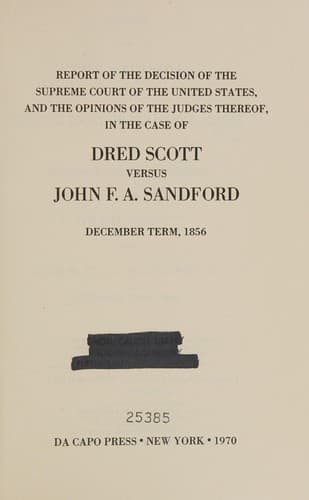
Report of the Decision of the Supreme Court of the United States, and the Opinions of the Judges Thereof, in the Case of Dred Scott versus John F. A. Sandford: December Term, 1856.United States. Supreme Court
History
Report of the Decision of the Supreme Court of the United States, and the Opinions of the Judges Thereof, in the Case of Dred Scott versus John F. A. Sandford: December Term, 1856.
United States. Supreme Court
Scott, Dred, 1809-1858; Slavery -- United States
By this same writer it is also said: "The citizens are the members of
the civil society; bound to this society by certain duties, and
subject to its authority; they _equally_ participate in its
advantages. The natives, or natural-born citizens, are those born in
the country, of parents who are citizens. As society cannot
perpetuate itself otherwise than by the children of the citizens,
those children naturally follow the condition of their parents, and
succeed to all their rights." Again: "I say, to be _of the country_,
it is necessary to be born of a person who is a _citizen_; for if he
be born there of a foreigner, it will be only the place of his
_birth_, and not his _country_. The inhabitants, as distinguished from
citizens, are foreigners who are permitted to settle and stay in the
country." (Vattel, Book 1, cap. 19, p. 101.)
From the views here expressed, and they seem to be unexceptionable, it
must follow, that with the _slave_, with one devoid of rights or
capacities, _civil or political_, there could be no pact; that one
thus situated could be no party to, or actor in, the association of
those possessing free will, power, discretion. He could form no part
of the design, no constituent ingredient or portion of a society based
upon _common_, that is, upon _equal_ interests and powers. He could
not at the same time be the sovereign and the slave.
But it has been insisted, in argument, that the emancipation of a
slave, effected either by the direct act and assent of the master, or
by causes operating in contravention of his will, produces a change in
the _status_ or capacities of the slave, such as will transform him
from a mere subject of property, into a being possessing a social,
civil, and political equality with a citizen. In other words, will
make him a citizen of the State within which he was, previously to his
emancipation, a slave.
It is difficult to conceive by what magic the mere _surcease_ or
renunciation of an interest in a subject of _property_, by an
individual possessing that interest, can alter the essential character
of that property with respect to persons or communities unconnected
with such renunciation. Can it be pretended that an individual in any
State, by his single act, though voluntarily or designedly performed,
yet without the co-operation or warrant of the Government, perhaps in
opposition to its policy or its guaranties, can create a citizen of
that State? Much more emphatically may it be asked, how such a result
could be accomplished by means wholly extraneous, and entirely foreign
to the Government of the State? The argument thus urged must lead to
these extraordinary conclusions. It is regarded at once as wholly
untenable, and as unsustained by the direct authority or by the
analogies of history.
Public-domain text, read in full here on John Shaqi.
Reviews
Reviews
No reviews yet
Be the first to share your thoughts on this work.
Elsewhere in the archive
Join the Discussion
Join the discussion
Sign in to leave a comment or review.
Sign InorCreate an account