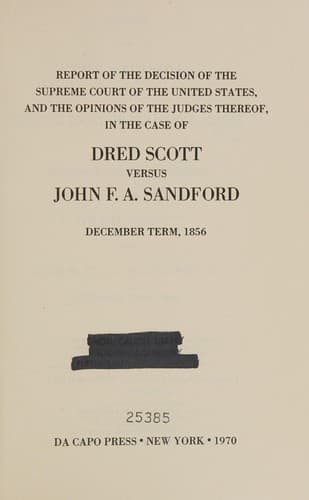
Report of the Decision of the Supreme Court of the United States, and the Opinions of the Judges Thereof, in the Case of Dred Scott versus John F. A. Sandford: December Term, 1856.United States. Supreme Court
History
Report of the Decision of the Supreme Court of the United States, and the Opinions of the Judges Thereof, in the Case of Dred Scott versus John F. A. Sandford: December Term, 1856.
United States. Supreme Court
Scott, Dred, 1809-1858; Slavery -- United States
By the references above given it is shown, from the nature and objects
of civil and political associations, and upon the direct authority of
history, that citizenship was not conferred by the simple fact of
emancipation, but that such a result was deduced therefrom in
violation of the fundamental principles of free political association;
by the exertion of despotic will to establish, under a false and
misapplied denomination, one equal and universal slavery; and to
effect this result required the exertions of absolute power--of a
power both in theory and practice, being in its most plenary
acceptation the SOVEREIGNTY, THE STATE ITSELF--it could not be
produced by a less or inferior authority, much less by the will or the
act of one who, with reference to civil and political rights, was
himself a _slave_. The master might abdicate or abandon his interest
or ownership in his property, but his act would be a mere abandonment.
It seems to involve an absurdity to impute to it the investiture of
rights which the sovereignty alone had power to impart. There is not
perhaps a community in which slavery is recognised, in which the power
of emancipation and the modes of its exercise are not regulated by
law--that is, by the sovereign authority; and none can fail to
comprehend the necessity for such regulation, for the preservation of
order, and even of political and social existence.
By the argument for the plaintiff in error, a power equally despotic
is vested in every member of the association, and the most obscure or
unworthy individual it comprises may arbitrarily invade and derange
its most deliberate and solemn ordinances. At assumptions anomalous as
these, so fraught with mischief and ruin, the mind at once is
revolted, and goes directly to the conclusions, that to change or to
abolish a fundamental principle of the society, must be the act of the
society itself--of the _sovereignty_; and that none other can admit to
a participation of that high attribute. It may further expose the
character of the argument urged for the plaintiff, to point out some
of the revolting consequences which it would authorize. If that
argument possesses any integrity, it asserts the power in any citizen,
or _quasi_ citizen, or a resident foreigner of any one of the States,
from a motive either of corruption or caprice, not only to infract the
inherent and necessary authority of such State, but also materially to
interfere with the organization of the Federal Government, and with
the authority of the separate and independent States. He may
emancipate his negro slave, by which process he first transforms that
slave into a citizen of his own State; he may next, under color of
article fourth, section second, of the Constitution of the United
States, obtrude him, and on terms of civil and political equality,
upon any and every State in this Union, in defiance of all regulations
of necessity or policy, ordained by those States for their internal
happiness or safety.
Public-domain text, read in full here on John Shaqi.
Reviews
Reviews
No reviews yet
Be the first to share your thoughts on this work.
Elsewhere in the archive
Join the Discussion
Join the discussion
Sign in to leave a comment or review.
Sign InorCreate an account