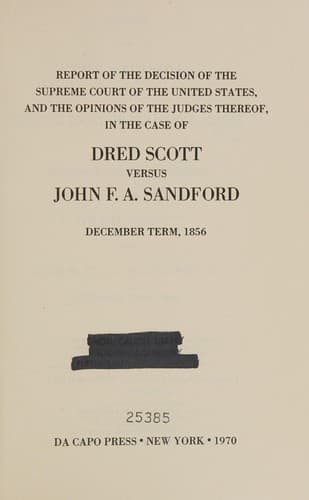
Report of the Decision of the Supreme Court of the United States, and the Opinions of the Judges Thereof, in the Case of Dred Scott versus John F. A. Sandford: December Term, 1856.United States. Supreme Court
History
Report of the Decision of the Supreme Court of the United States, and the Opinions of the Judges Thereof, in the Case of Dred Scott versus John F. A. Sandford: December Term, 1856.
United States. Supreme Court
Scott, Dred, 1809-1858; Slavery -- United States
duties of obedience and gratitude; whatever were the fruits of their
industry, their patron and his family inherited the third part, or
even the whole of their fortune, if they died without children and
without a testament. Justinian respected the rights of patrons, but
his indulgence removed the badge of disgrace from the two inferior
orders of freedmen; whoever ceased to be a slave, obtained without
reserve or delay the station of a citizen; and at length the dignity
of an ingenuous birth _was created_ or _supposed_ by the omnipotence
of the emperor."[1]
[Footnote 1: Vide Gibbons's Decline and Fall of the Roman Empire.
London edition of 1825, vol. 3d, chap. 44, p. 183.]
The above account of slavery and its modifications will be found in
strictest conformity with the Institutes of Justinian. Thus, book 1st,
title 3d, it is said: "The first general division of persons in
respect to their rights is into freemen and slaves." The same title,
sec. 4th: "Slaves are born such, or become so. They are born such of
bondwomen; they become so either by _the law of nations_, as by
capture, or by the civil law." Section 5th: "In the condition of
slaves there is no diversity; but among free persons there are many.
Thus some are _ingenui_ or freemen, others _libertini_ or freedmen."
Tit. 4th. DE INGENUIS.--"A freeman is one who is born free by being
born in matrimony, of parents who both are free, or both freed; or of
parents one free and the other freed. But one born of a free mother,
although the father be a slave or unknown, is free."
Tit. 5th. DE LIBERTINIS.--"Freedmen are those who have been manumitted
from just servitude."
Section third of the same title states that "freedmen were formerly
distinguished by a threefold division." But the emperor proceeds to
say: "Our _piety_ leading us to reduce all things into a better state,
we have amended our laws, and re-established the ancient usage; for
anciently liberty was simple and undivided--that is, was conferred
upon the slave as his manumittor possessed it, admitting this single
difference, that the person manumitted became only a _freed man_,
although his manumittor was a _free_ man." And he further declares:
"We have made all freed men in general become citizens of Rome,
regarding neither the age of the manumitted, nor the manumittor, nor
the ancient forms of manumission. We have also introduced many new
methods by which _slaves_ may become Roman citizens."
Public-domain text, read in full here on John Shaqi.
Reviews
Reviews
No reviews yet
Be the first to share your thoughts on this work.
Elsewhere in the archive
Join the Discussion
Join the discussion
Sign in to leave a comment or review.
Sign InorCreate an account