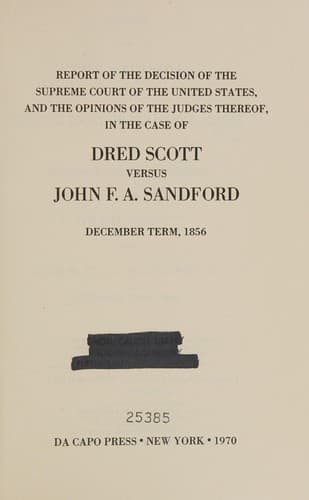
Report of the Decision of the Supreme Court of the United States, and the Opinions of the Judges Thereof, in the Case of Dred Scott versus John F. A. Sandford: December Term, 1856.United States. Supreme Court
History
Report of the Decision of the Supreme Court of the United States, and the Opinions of the Judges Thereof, in the Case of Dred Scott versus John F. A. Sandford: December Term, 1856.
United States. Supreme Court
Scott, Dred, 1809-1858; Slavery -- United States
According to the view taken of the law, as applicable to the demurrer
to the plea in abatement in this cause, the questions subsequently
raised upon the several pleas in bar might be passed by, as requiring
neither a particular examination, nor an adjudication directly upon
them. But as these questions are intrinsically of primary interest and
magnitude, and have been elaborately discussed in argument, and as
with respect to them the opinions of a majority of the court,
including my own, are perfectly coincident, to me it seems proper that
they should here be fully considered, and, so far as it is practicable
for this court to accomplish such an end, finally put to rest.
The questions then to be considered upon the several pleas in bar, and
upon the agreed statement of facts between the counsel, are: 1st.
Whether the admitted master and owner of the plaintiff, holding him as
his slave in the State of Missouri, and in conformity with his rights
guarantied to him by the laws of Missouri then and still in force, by
carrying with him for his own benefit and accommodation, and as his
own slave, the person of the plaintiff into the State of Illinois,
within which State slavery had been prohibited by the Constitution
thereof, and by retaining the plaintiff during the commorancy of the
master within the State of Illinois, had, upon his return with his
slave into the State of Missouri, forfeited his rights as master, by
reason of any supposed operation of the prohibitory provision in the
Constitution of Illinois, beyond the proper territorial jurisdiction
of the latter State? 2d. Whether a similar removal of the plaintiff by
his master from the State of Missouri, and his retention in service at
a point included within no State, but situated north of thirty-six
degrees thirty minutes of north latitude, worked a forfeiture of the
right of property of the master, and the manumission of the plaintiff?
In considering the first of these questions, the acts or declarations
of the master, as expressive of his purpose to emancipate, may be
thrown out of view, since none will deny the right of the owner to
relinquish his interest in any subject of property, at any time or in
any place. The inquiry here bears no relation to acts or declarations
of the owner as expressive of his intent or purpose to make such a
relinquishment; it is simply a question whether, irrespective of such
purpose, and in opposition thereto, that relinquishment can be
enforced against the owner of property within his own country, in
defiance of every guaranty promised by its laws; and this through the
instrumentality of a claim to power entirely foreign and extraneous
with reference to himself, to the origin and foundation of his title,
and to the independent authority of his country. A conclusive negative
answer to such an inquiry is at once supplied, by announcing a few
familiar and settled principles and doctrines of public law.
Public-domain text, read in full here on John Shaqi.
Reviews
Reviews
No reviews yet
Be the first to share your thoughts on this work.
Elsewhere in the archive
Join the Discussion
Join the discussion
Sign in to leave a comment or review.
Sign InorCreate an account