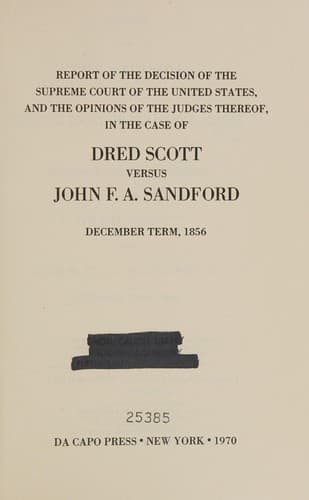
Report of the Decision of the Supreme Court of the United States, and the Opinions of the Judges Thereof, in the Case of Dred Scott versus John F. A. Sandford: December Term, 1856.United States. Supreme Court
History
Report of the Decision of the Supreme Court of the United States, and the Opinions of the Judges Thereof, in the Case of Dred Scott versus John F. A. Sandford: December Term, 1856.
United States. Supreme Court
Scott, Dred, 1809-1858; Slavery -- United States
Vattel, in his chapter on the general principles of the laws of
nations, section 15th, tells us, that "nations being free and
independent of each other in the same manner that men are naturally
free and independent, the second general law of their society is, that
each nation should be left in the peaceable enjoyment of that liberty
which she inherits from nature."
"The natural society of nations," says this writer, "cannot subsist
unless the natural rights of each be respected." In section 16th he
says, "as a consequence of that liberty and independence, it
exclusively belongs to each nation to form her own judgment of what
her conscience prescribes for her--of what it is proper or improper
for her to do; and of course it rests solely with her to examine and
determine whether she can perform any office for another nation
without neglecting the duty she owes to herself. In all cases,
therefore, in which a nation has the right of judging what her duty
requires, no other nation can compel her to act in such or such a
particular manner, for any attempt at such compulsion would be an
infringement on the liberty of nations." Again, in section 18th, of
the same chapter, "nations composed of men, and considered as so many
free persons living together in a state of nature, are naturally
equal, and inherit from nature the same obligations and rights. Power
or weakness does not produce any difference. A small republic is no
less a sovereign state than the most powerful kingdom."
So, in section 20: "A nation, then, is mistress of her own actions, so
long as they do not affect the proper and _perfect rights_ of any
other nation--so long as she is only _internally_ bound, and does not
lie under any _external_ and _perfect_ obligation. If she makes an ill
use of her liberty, she is guilty of a breach of duty; but other
nations are bound to acquiesce in her conduct, since they have no
right to dictate to her. Since nations are _free_, _independent_, and
_equal_, and since each possesses the right of judging, according to
the dictates of her conscience, what conduct she is to pursue, in
order to fulfil her duties, the effect of the whole is to produce, at
least externally, in the eyes of mankind, a perfect equality of rights
between nations, in the administration of their affairs, and in the
pursuit of their pretensions, without regard to the intrinsic justice
of their conduct, of which others have no right to form a definitive
judgment."
Public-domain text, read in full here on John Shaqi.
Reviews
Reviews
No reviews yet
Be the first to share your thoughts on this work.
Elsewhere in the archive
Join the Discussion
Join the discussion
Sign in to leave a comment or review.
Sign InorCreate an account