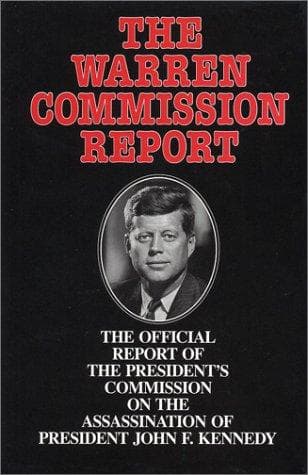
Report of the President's Commission on the Assassination of President John F. KennedyUnited States. Warren Commission
History
Report of the President's Commission on the Assassination of President John F. Kennedy
United States. Warren Commission
Kennedy, John F. (John Fitzgerald), 1917-1963 -- Assassination; Oswald, Lee Harvey
When the President’s clothing was removed at Parkland Hospital, his tie
was cut off by severing the loop immediately to the wearer’s left of
the knot, leaving the knot in its original condition.[C3-206] The tie
had a nick on the left side of the knot.[C3-207] The nick was elongated
horizontally, indicating that the tear was made by some object moving
horizontally, but the fibers were not affected in a manner which would
shed light on the direction or the nature of the missile.[C3-208]
The Governor’s Wounds
While riding in the right jump seat of the Presidential limousine
on November 22, Governor Connally sustained wounds of the back,
chest, right wrist and left thigh. Because of the small size and
clean-cut edges of the wound on the Governor’s back, Dr. Robert Shaw
concluded that it was an entry wound.[C3-209] The bullet traversed
the Governor’s chest in a downward angle, shattering his fifth rib,
and exited below the right nipple.[C3-210] The ragged edges of the
2-inch (5 centimeters) opening on the front of the chest led Dr. Shaw
to conclude that it was the exit point of the bullet.[C3-211] When
Governor Connally testified before the Commission 5 months after
the assassination, on April 21, 1964, the Commission observed the
Governor’s chest wounds, as well as the injuries to his wrist and thigh
and watched Dr. Shaw measure with a caliper an angle of declination of
25° from the point of entry on the back to the point of exit on the
front of the Governor’s chest.[C3-212]
At the time of the shooting, Governor Connally was unaware that he had
sustained any injuries other than his chest wounds.[C3-213] On the back
of his arm, about 2 inches (5 centimeters) above the wrist joint on
the thumb side, Dr. Charles F. Gregory observed a linear perforating
wound approximately one-fifth of an inch (one-half centimeter) wide
and 1 inch (2½ centimeters) long.[C3-214] During his operation on this
injury, the doctor concluded that this ragged wound was the point of
entry because thread and cloth had been carried into the wound to the
region of the bone.[C3-215] Dr. Gregory’s conclusions were also based
upon the location in the Governor’s wrist, as revealed by X-ray, of
small fragments of metal shed by the missile upon striking the firm
surface of the bone.[C3-216] Evidence of different amounts of air in
the tissues of the wrist gave further indication that the bullet passed
from the back to the front of the wrist.[C3-217] An examination of the
palm surface of the wrist showed a wound approximately one-fifth of
an inch (one-half centimeter) long and approximately three-fourths of
an inch (2 centimeters) above the crease of the right wrist.[C3-218]
Dr. Shaw had initially believed that the missile entered on the palm
side of the Governor’s wrist and exited on the back side.[C3-219]
After reviewing the factors considered by Dr. Gregory, however, Dr.
Shaw withdrew his earlier opinion. He deferred to the judgment of Dr.
Public-domain text, read in full here on John Shaqi.
Reviews
Reviews
No reviews yet
Be the first to share your thoughts on this work.
Elsewhere in the archive
Join the Discussion
Join the discussion
Sign in to leave a comment or review.
Sign InorCreate an account