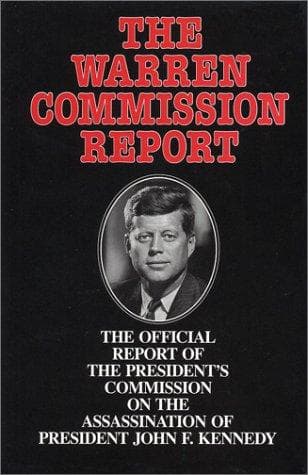
Report of the President's Commission on the Assassination of President John F. KennedyUnited States. Warren Commission
History
Report of the President's Commission on the Assassination of President John F. Kennedy
United States. Warren Commission
Kennedy, John F. (John Fitzgerald), 1917-1963 -- Assassination; Oswald, Lee Harvey
Examination of the Zapruder motion picture camera by the FBI
established that 18.3 pictures or frames were taken each second,
and therefore, the timing of certain events could be calculated by
allowing 1/18.3 seconds for the action depicted from one frame to the
next.[C3-264] The films and slides made from individual frames were
viewed by Governor and Mrs. Connally, the Governor’s doctors, the
autopsy surgeons, and the Army wound ballistics scientists in order
to apply the knowledge of each to determine the precise course of
events.[C3-265] Tests of the assassin’s rifle disclosed that at least
2.3 seconds were required between shots.[C3-266] In evaluating the
films in the light of these timing guides, it was kept in mind that
a victim of a bullet wound may not react immediately and, in some
situations, according to experts, the victim may not even know where he
has been hit, or when.[C3-267]
On May 24, 1964, agents of the FBI and Secret Service conducted a
series of tests to determine as precisely as possible what happened
on November 22, 1963. Since the Presidential limousine was being
remodeled and was therefore unavailable, it was simulated by using
the Secret Service followup car, which is similar in design.[C3-268]
Any differences were taken into account. Two Bureau agents with
approximately the same physical characteristics sat in the car in the
same relative positions as President Kennedy and Governor Connally had
occupied. The back of the stand-in for the President was marked with
chalk at the point where the bullet entered. The Governor’s model had
on the same coat worn by Governor Connally when he was shot, with the
hole in the back circled in chalk.[C3-269]
To simulate the conditions which existed at the assassination scene
on November 22, the lower part of the sixth-floor window at the
southeast corner of the Depository Building was raised halfway, the
cardboard boxes were repositioned, the C2766 Mannlicher-Carcano rifle
found on the sixth floor of the Depository was used, and mounted on
that rifle was a camera which recorded the view as was seen by the
assassin.[C3-270] In addition, the Zapruder, Nix, and Muchmore cameras
were on hand so that photographs taken by these cameras from the same
locations where they were used on November 22, 1963, could be compared
with the films of that date.[C3-271] The agents ascertained that the
foliage of an oak tree that came between the gunman and his target
along the motorcade route on Elm Street was approximately the same as
on the day of the assassination.[C3-272]
The First Bullet That Hit
Public-domain text, read in full here on John Shaqi.
Reviews
Reviews
No reviews yet
Be the first to share your thoughts on this work.
Elsewhere in the archive
Join the Discussion
Join the discussion
Sign in to leave a comment or review.
Sign InorCreate an account