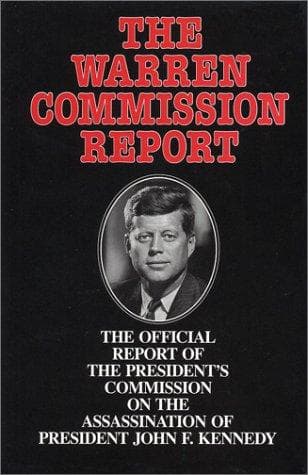
Report of the President's Commission on the Assassination of President John F. KennedyUnited States. Warren Commission
History
Report of the President's Commission on the Assassination of President John F. Kennedy
United States. Warren Commission
Kennedy, John F. (John Fitzgerald), 1917-1963 -- Assassination; Oswald, Lee Harvey
_Additional corroborative evidence._--The admissions made to Marina
Oswald by her husband are an important element in the evidence that Lee
Harvey Oswald fired the shot at General Walker. As shown above, the
note and the photographs of Walker’s house and of the nearby railroad
tracks provide important corroboration for her account of the incident.
Other details described by Marina Oswald coincide with facts developed
independently of her statements. She testified that her husband had
postponed his attempt to kill Walker until that Wednesday because he
had heard that there was to be a gathering at the church next door
to Walker’s house on that evening. He indicated that he wanted more
people in the vicinity at the time of the attempt so that his arrival
and departure would not attract great attention.[C4-737] An official
of this church told FBI agents that services are held every Wednesday
at the church except during the month of August.[C4-738] Marina Oswald
also testified that her husband had used a bus to return home.[C4-739]
A study of the bus routes indicates that Oswald could have taken any
one of several different buses to Walker’s house or to a point near the
railroad tracks where he may have concealed the rifle.[C4-740] It would
have been possible for him to take different routes in approaching and
leaving the scene of the shooting.
_Conclusion._--Based on (1) the contents of the note which Oswald
left for his wife on April 10, 1963, (2) the photographs found among
Oswald’s possessions, (3) the testimony of firearms identification
experts, and (4) the testimony of Marina Oswald, the Commission has
concluded that Lee Harvey Oswald attempted to take the life of Maj.
Gen. Edwin A. Walker (Resigned, U.S. Army) on April 10, 1963. The
finding that Lee Harvey Oswald attempted to murder a public figure in
April 1963 was considered of probative value in this investigation,
although the Commission’s conclusion concerning the identity of the
assassin was based on evidence independent of the finding that Oswald
attempted to kill General Walker.
Richard M. Nixon Incident
Another alleged threat by Oswald against a public figure involved
former Vice President Richard M. Nixon. In January 1964, Marina Oswald
and her business manager, James Martin, told Robert Oswald, Lee Harvey
Oswald’s brother, that Oswald had once threatened to shoot former
Vice President Richard M. Nixon.[C4-741] When Marina Oswald testified
before the Commission on February 3-6, 1964, she had failed to mention
the incident when she was asked whether Oswald had ever expressed
any hostility toward any official of the United States.[C4-742] The
Commission first learned of this incident when Robert Oswald related it
to FBI agents on February 19, 1964,[C4-743] and to the Commission on
February 21.[C4-744]
Public-domain text, read in full here on John Shaqi.
Reviews
Reviews
No reviews yet
Be the first to share your thoughts on this work.
Elsewhere in the archive
Join the Discussion
Join the discussion
Sign in to leave a comment or review.
Sign InorCreate an account