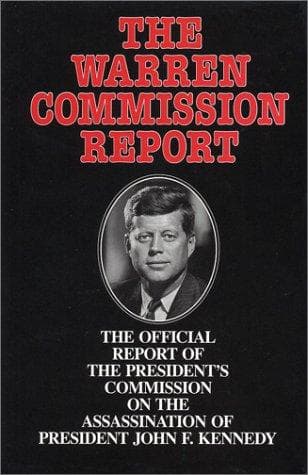
Report of the President's Commission on the Assassination of President John F. KennedyUnited States. Warren Commission
History
Report of the President's Commission on the Assassination of President John F. Kennedy
United States. Warren Commission
Kennedy, John F. (John Fitzgerald), 1917-1963 -- Assassination; Oswald, Lee Harvey
Curry had instructed the reporters that they were not to “ask any
questions and try to interview * * * [Oswald] in any way,” but when he
was brought into the room, “immediately they began to shoot questions
at him and shove microphones into his face.”[C5-91] It was difficult
to hear Oswald’s answers above the uproar. Cameramen stood on the
tables to take pictures and others pushed forward to get close-ups.
(See Commission Exhibit No. 2965, p. 207.) The noise and confusion
mounted as reporters shouted at each other to get out of the way and
camermen made frantic efforts to get into position for pictures.[C5-92]
After Oswald had been in the room only a few minutes, Chief Curry
intervened and directed that Oswald be taken back to the jail because,
he testified, the newsmen “tried to overrun him.”[C5-93]
THE ABORTIVE TRANSFER
In Dallas, after a person is charged with a felony, the county sheriff
ordinarily takes custody of the prisoner and assumes responsibility for
his safekeeping. Normally, the Dallas Police Department notifies the
sheriff when a prisoner has been charged with a felony and the sheriff
dispatches his deputies to transport the accused to the county jail.
This is usually done within a few hours after the complaint has been
filed. In cases of unusual importance, however, the Dallas city police
sometimes transport the prisoners to the county jail.[C5-94]
The decision to move Oswald to the county jail on Sunday morning
was reached by Chief Curry the preceding evening. Sometime after
7:30 Saturday evening, according to Assistant Chief Batchelor, two
reporters told him that they wanted to go out to dinner but that “they
didn’t want to miss anything if we were going to move the prisoner.”
Curry came upon them at that point and told the two newsmen that
if they returned by 10 o’clock in the morning, they wouldn’t “miss
anything.”[C5-95] A little later, after checking with Captain Fritz,
Curry made a similar announcement to the assembled reporters. Curry
reported the making of his decision to move Oswald as follows:
Then, I talked to Fritz about when he thought he would transfer
the prisoner, and he didn’t think it was a good idea to
transfer him at night because of the fact you couldn’t see, and
if anybody tried to cause them any trouble, they needed to see
who they were and where it was coming from and so forth, and
he suggested that we wait until daylight, so this was normal
procedure, I mean, for Fritz to determine when he is going to
transfer his prisoners, so I told him “Okay.” I asked him, I
said, “What time do you think you will be ready tomorrow?”
And he didn’t know exactly and I said, “Do you think about 10
o’clock,” and he said, “I believe so,” and then is when I went
out and told the newspaper people * * * “I believe if you are
back here by 10 o’clock you will be back in time to observe
anything you care to observe.”[C5-96]
Public-domain text, read in full here on John Shaqi.
Reviews
Reviews
No reviews yet
Be the first to share your thoughts on this work.
Elsewhere in the archive
Join the Discussion
Join the discussion
Sign in to leave a comment or review.
Sign InorCreate an account