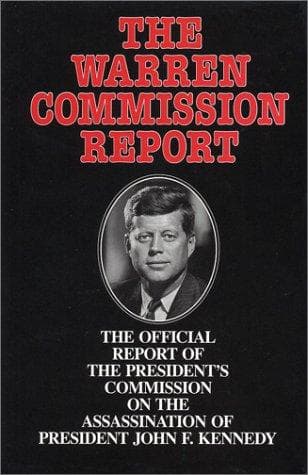
Report of the President's Commission on the Assassination of President John F. KennedyUnited States. Warren Commission
History
Report of the President's Commission on the Assassination of President John F. Kennedy
United States. Warren Commission
Kennedy, John F. (John Fitzgerald), 1917-1963 -- Assassination; Oswald, Lee Harvey
The running commentary on the investigation by the police inevitably
carried with it the disclosure of many details that proved to be
erroneous. In their efforts to keep the public abreast of the
investigation, the police reported hearsay items and unverified
leads; further investigation proved many of these to be incorrect or
inaccurate. For example, the rifle found on the sixth floor of the
Texas School Book Depository Building was initially identified as a
Mauser 7.65 rather than a Mannlicher-Carcano 6.5 because a deputy
constable who was one of the first to see it thought it looked like a
Mauser. He neither handled the weapon nor saw it at close range.[C5-228]
Police sources were also responsible for the mistaken notion that the
chicken bones found on the sixth floor were the remains of Oswald’s
lunch. They had in fact been left by another employee who ate his lunch
there at least 15 minutes before the assassination.[C5-229] Curry
repeated the erroneous report that a Negro had picked up Oswald near
the scene of the assassination and driven him across town.[C5-230]
It was also reported that the map found in Oswald’s room contained a
marked route of the Presidential motorcade when it actually contained
markings of places where Oswald may have applied for jobs, including,
of course, the Texas School Book Depository.[C5-231]
Concern about the effects of the unlimited disclosures was being
voiced by Saturday morning. According to District Attorney Wade,
he received calls from lawyers in Dallas and elsewhere expressing
concern about providing an attorney for Oswald and about the amount of
information being given to the press by the police and the district
attorney.[C5-232] Curry continued to answer questions on television and
radio during the remainder of the day and Sunday morning.[C5-233]
FBI Director J. Edgar Hoover became concerned because “almost as
soon as * * * [FBI Laboratory reports] would reach the Dallas Police
Department, the chief of police or one of the representatives of the
department would go on TV or radio and relate findings of the FBI,
giving information such as the identification of the gun and other
items of physical evidence.”[C5-234] On Sunday, after Oswald was
shot, Hoover dispatched a personal message to Curry requesting him
“not to go on the air any more until this case * * * [is] resolved.”
Hoover testified later that Curry agreed not to make any more
statements.[C5-235]
The shooting of Oswald shocked the Dallas police, and after the
interviews that immediately followed the shooting they were disposed
to remain silent. Chief Curry made only one more television appearance
after the shooting. At 1:30 p.m., he descended to the assembly room
where, tersely and grimly, he announced Oswald’s death. He refused to
answer any of the questions shouted at him by the persistent reporters,
concluding the conference in less than a minute.[C5-236]
Public-domain text, read in full here on John Shaqi.
Reviews
Reviews
No reviews yet
Be the first to share your thoughts on this work.
Elsewhere in the archive
Join the Discussion
Join the discussion
Sign in to leave a comment or review.
Sign InorCreate an account