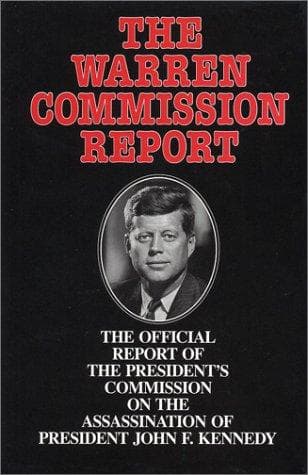
Report of the President's Commission on the Assassination of President John F. KennedyUnited States. Warren Commission
History
Report of the President's Commission on the Assassination of President John F. Kennedy
United States. Warren Commission
Kennedy, John F. (John Fitzgerald), 1917-1963 -- Assassination; Oswald, Lee Harvey
He liked to create the pretense, the impression that he was
attracted to abstract discussion and was capable of engaging in
it, and was drawn to it. But it was like pricking a balloon.
I had the feeling that if you really did engage him on this
ground, you very quickly would discover that he didn’t have
the capacity for a logical sustained argument about an abstract
point on economics or on noneconomic, political matters or any
matter, philosophical.[C6-175]
[Illustration: COMMISSION EXHIBIT NO. 912
LETTER MAILED BY OSWALD TO THE AMERICAN EMBASSY IN MOSCOW.]
[Illustration: COMMISSION EXHIBIT NO. 24
OSWALD’S OWN ACCOUNT OF HIS MEETING AT THE AMERICAN EMBASSY IN MOSCOW
OCT. 31, 1959
Excerpts from his “Historic Diary”]
A comparison of the formal note Oswald handed Snyder[C6-176] and his
letter of November 3[C6-177] with the provisions of section 349(a)
of the Immigration and Nationality Act[C6-178] suggests that Oswald
had read the statute but understood it imperfectly; he apparently was
trying to use three out of the four ways set out in the statute to
surrender his citizenship, but he succeeded in none.
Moreover, persuasive evidence that Oswald’s conduct was not carefully
coached by Soviet agents is provided by some of his actions at the
Embassy. The single statement which probably caused Oswald the most
future trouble was his declaration that he had already volunteered to a
Soviet official that he would, if asked, tell the Soviet Government all
that he knew about his job in radar as a Marine. Certainly a statement
of this type would prejudice any possibility of his being an effective
pro-Communist agent.
Further, though unquestionably evidencing anti-American sentiments,
Oswald’s behavior at the Embassy, which brought him exceedingly close
to expatriation, was unlikely to have increased his value in any
capacity to the Soviet Union. Richard E. Snyder, the official who
interviewed Oswald on October 31, testified that he “had every reason
to believe” that Oswald would have carried through a formal--and
therefore effective--renunciation of his American citizenship
immediately if he had let him.[C6-179] However, as a defector, Oswald
could have had considerable propaganda value without expatriating
himself; and if he had expatriated himself his eventual return to
the United States would have been much more difficult and perhaps
impossible. If Snyder’s assessment of Oswald’s intentions is accurate,
it thus tends to refute the suggestion that Oswald was being coached
by the Soviets. In addition, reporters noticed Oswald’s apparent
ambivalence in regard to renouncing his citizenship--stormily demanding
that he be permitted to renounce while failing to follow through by
completing the necessary papers[C6-180]--behavior which might have
detracted from his propaganda value.
Public-domain text, read in full here on John Shaqi.
Reviews
Reviews
No reviews yet
Be the first to share your thoughts on this work.
Elsewhere in the archive
Join the Discussion
Join the discussion
Sign in to leave a comment or review.
Sign InorCreate an account