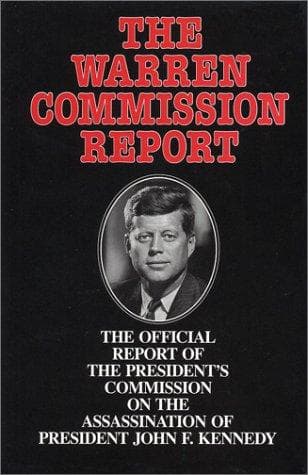
Report of the President's Commission on the Assassination of President John F. KennedyUnited States. Warren Commission
History
Report of the President's Commission on the Assassination of President John F. Kennedy
United States. Warren Commission
Kennedy, John F. (John Fitzgerald), 1917-1963 -- Assassination; Oswald, Lee Harvey
The Embassy’s response to this letter was to invite Oswald to
come personally to Moscow to discuss the matter.[C6-253] Oswald
at first protested because of the difficulty of obtaining Soviet
permission.[C6-254] He wrote two more protesting letters during the
following 4 months,[C6-255] but received no indication that the Embassy
would allow him to handle the matter by mail.[C6-256] While the
Department of State was clarifying its position on this matter,[C6-257]
Oswald unexpectedly appeared in Moscow on Saturday, July 8,
1961.[C6-258] On Sunday, Marina Oswald flew to Moscow,[C6-259] and was
interviewed by officials in the American Embassy on Tuesday.[C6-260]
The Commission asked the Department of State and the Central
Intelligence Agency to comment on whether the Oswalds’ travel to Moscow
without permission signified special treatment by the Soviet Union.
From their responses, it appears that since Marina Oswald possessed a
Soviet citizen’s internal passport, she did not require prior approval
to make the trip.[C6-261] Although Soviet law did require her husband,
as the holder of a “stateless passport,” to obtain advance permission
for the trip, his failure to do so would not normally have been
considered a serious violation. In this respect, the CIA has advised
the Commission as follows:
OSWALD’S travel from Minsk to Moscow and return in July 1961
would normally have required prior authorization. Bearers of a
Soviet “passport for foreigners” (_vid na zhitelstov v. SSSR
dlya innostrantsa_) are required to obtain travel authorization
from the Visa and Registration Department (OVIR) (or Passport
Registration Department (PRO) in smaller towns) if they desire
to leave the city (or oblast) where they are domiciled.
This same requirement is believed to apply to persons, such
as OSWALD, holding Soviet “stateless passports” (_vid na
zhitelstvo_ v. _SSSR dlya lits bez grazhdanstva_).
The practicality of even “unauthorized” travel was demonstrated
by events related by a United States citizen who defected
in 1960, and subsequently was sent to Kiev to study. After
repatriating this defector told U.S. authorities he had made
a total of seven unauthorized trips from Kiev during his stay
in the USSR. He was apprehended on two of his flights and was
returned to Kiev each time, the second time under escort. On
both occasions he was merely reprimanded by the deputy chief
of the institute at which he was studying. Since Marina had a
Soviet citizen’s internal passport there would have been no
restrictions against her making the trip to Moscow.[C6-262]
The answers of the Department of State, together with the Commission’s
specific questions, are as follows:
B. Could resident foreigners normally travel in this manner
without first obtaining such permission?
Public-domain text, read in full here on John Shaqi.
Reviews
Reviews
No reviews yet
Be the first to share your thoughts on this work.
Elsewhere in the archive
Join the Discussion
Join the discussion
Sign in to leave a comment or review.
Sign InorCreate an account