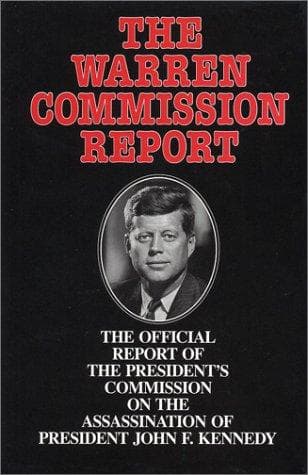
Report of the President's Commission on the Assassination of President John F. KennedyUnited States. Warren Commission
History
Report of the President's Commission on the Assassination of President John F. Kennedy
United States. Warren Commission
Kennedy, John F. (John Fitzgerald), 1917-1963 -- Assassination; Oswald, Lee Harvey
Notwithstanding these requirements, we know that at least
one “stateless” person often traveled without permission of
the authorities and stated that police stationed at railroad
stations usually spotchecked the identification papers of
every tenth traveler, but that it was an easy matter to avoid
such checks. Finally, she stated that persons who were caught
evading the registration requirements were returned to their
home towns by the police and sentenced to short jail terms
and fined. These sentences were more severe for repeated
violations.[C6-263]
When Oswald arrived at the Embassy in Moscow, he met Richard E. Snyder,
the same person with whom he had dealt in October of 1959.[C6-264]
Primarily on the basis of Oswald’s interview with Snyder on Monday,
July 10, 1961, the American Embassy concluded that Oswald had not
expatriated himself.[C6-265] (See app. XV, pp. 752-760.) On the
basis of this tentative decision, Oswald was given back his American
passport, which he had surrendered in 1959.[C6-266] The document was
due to expire in September 1961,[C6-267] however, and Oswald was
informed that its renewal would depend upon the ultimate decision by
the Department of State on his expatriation.[C6-268] On July 11, Marina
Oswald was interviewed at the Embassy and the steps necessary for her
to obtain an American visa were begun.[C6-269] In May 1962, after 15
months of dealings with the Embassy, Oswald’s passport was ultimately
renewed and permission for his wife to enter the United States was
granted.[C6-270]
The files on Oswald and his wife compiled by the Department of State
and the Immigration and Naturalization Service contain no indication
of any expert guidance by Soviet authorities in Oswald’s dealings with
the Department or the Service. For example, the letters from Minsk to
the Embassy in Moscow,[C6-271] which are in his handwriting,[C6-272]
display the arrogant attitude which was characteristic of him both
before and after he lived in Russia, and, when compared with other
letters that were without doubt composed and written by him,[C6-273]
show about the same low level of sophistication, fluency, and spelling.
The Department officer who most frequently dealt with Oswald when he
began negotiations to return to the United States, Richard E. Snyder,
testified that he can recall nothing that indicated Oswald was being
guided or assisted by a third party when he appeared at the Embassy
in July 1961.[C6-274] On the contrary, the arrogant and presumptuous
attitude which Oswald displayed in his correspondence with the Embassy
from early 1961 until June 1962,[C6-275] when he finally departed from
Russia, undoubtedly hindered his attempts to return to the United
States. Snyder has testified that although he made a sincere effort to
treat Oswald’s application objectively, Oswald’s attitude made this
very difficult.[C6-276]
Public-domain text, read in full here on John Shaqi.
Reviews
Reviews
No reviews yet
Be the first to share your thoughts on this work.
Elsewhere in the archive
Join the Discussion
Join the discussion
Sign in to leave a comment or review.
Sign InorCreate an account