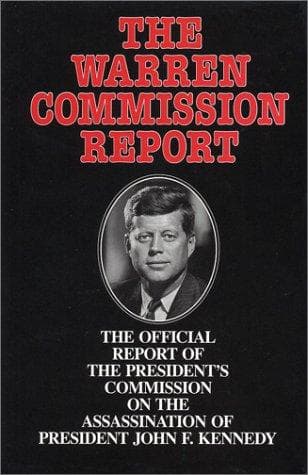
Report of the President's Commission on the Assassination of President John F. KennedyUnited States. Warren Commission
History
Report of the President's Commission on the Assassination of President John F. Kennedy
United States. Warren Commission
Kennedy, John F. (John Fitzgerald), 1917-1963 -- Assassination; Oswald, Lee Harvey
Oswald also attempted to initiate other dealings with the Communist
Party, U.S.A., but the organization was not especially responsive.
From New Orleans, he informed the party of his activities in
connection with the Fair Play for Cuba Committee, discussed below,
submitting membership cards in his fictitious chapter to several party
officials.[C6-406] In a letter from Arnold S. Johnson, director of
the information and lecture bureau of the party, Oswald was informed
that although the Communist Party had no “organizational ties” with
the committee, the party issued much literature which was “important
for anybody who is concerned about developments in Cuba.”[C6-407] In
September 1963 Oswald inquired how he might contact the party when
he relocated in the Baltimore-Washington area, as he said he planned
to do in October, and Johnson suggested in a letter of September 19
that he “get in touch with us here [New York] and we will find some
way of getting in touch with you in that city [Baltimore].”[C6-408]
However, Oswald had also written asking whether, “handicapped as it
were, by * * * [his] past record,” he could “still * * * compete with
antiprogressive forces, above ground or whether in your opinion * * *
[he] should always remain in the background, i.e., underground,” and in
the September 19 letter received the reply that “often it is advisable
for some people to remain in the background, not underground.”[C6-409]
In a letter postmarked November 1, Oswald informed the party that
he had moved to Dallas, and reported his attendance at a meeting at
which General Walker had spoken, and at a meeting of the American
Civil Liberties Union; he asked Johnson for the party’s “general view”
of the latter organization and “to what degree, if any, [he] should
attempt to highten its progressive tendencies.” According to Johnson,
this letter was not received by the Communist Party until after the
assassination.[C6-410] At different times, Oswald also wrote the
Worker and the Hall-Davis Defense Committee, enclosing samples of his
photographic work and offering to assist in preparing posters; he was
told that “his kind offer [was] most welcomed and from time to time we
shall call on you,” but he was never asked for assistance.[C6-411] The
correspondence between Oswald and the Communist Party, and with all
other organizations, is printed in the record accompanying this report.
Public-domain text, read in full here on John Shaqi.
Reviews
Reviews
No reviews yet
Be the first to share your thoughts on this work.
Elsewhere in the archive
Join the Discussion
Join the discussion
Sign in to leave a comment or review.
Sign InorCreate an account