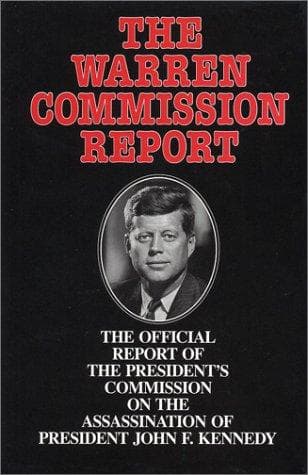
Report of the President's Commission on the Assassination of President John F. KennedyUnited States. Warren Commission
History
Report of the President's Commission on the Assassination of President John F. Kennedy
United States. Warren Commission
Kennedy, John F. (John Fitzgerald), 1917-1963 -- Assassination; Oswald, Lee Harvey
In the light of Oswald’s attack upon General Walker on the evening of
April 10, 1963, discussed in chapter IV,[C6-450] as well as Oswald’s
known political views,[C6-451] his asserted attendance at the political
rally at which General Walker spoke may have been induced by many
possible motives. However, there is no evidence that Oswald attended
any other rightist meetings or was associated with any politically
conservative organizations.
While the black-bordered “Welcome Mr. Kennedy” advertisement in
the November 22 Dallas Morning News, which addressed a series of
critical questions to the President, probably did not come to Oswald’s
attention, it was of interest to the Commission because of its
appearance on the day of the assassination and because of an allegation
made before the Commission concerning the person whose name appeared
as the chairman of the committee sponsoring the advertisement.
The black-bordered advertisement was purported to be sponsored by
“The American Fact-Finding Committee,” which was described as “An
unaffiliated and nonpartisan group of citizens who wish truth.” Bernard
Weissman was listed as “Chairman” and a post office box in Dallas was
the only address. (See Commission Exhibit No. 1031, p. 294.)
[Illustration: COMMISSION EXHIBIT NO. 1031]
The Commission has conducted a full investigation into the genesis of
this advertisement and the background of those responsible for it.
Three of the four men chiefly responsible, Bernard W. Weissman, William
B. Burley III, and Larrie H. Schmidt, had served together in the U.S.
Army in Munich, Germany, in 1962. During that time they had with
others devised plans to develop two conservative organizations, one
political and the other business. The political entity was to be named
Conservatism--USA, or CUSA, and the business entity was to be named
American Business, or AMBUS.[C6-452] While in Munich, according to
Weissman, they attempted to develop in their “own minds * * * ways to
build up various businesses that would support us and at the same time
support our political activities.”[C6-453] According to a subsequent
letter from Schmidt to Weissman, “Cusa was founded for patriotic
reasons rather than for personal gain--even though, as a side effect,
Ambus was to have brought great return, as any business endeavor
should.”[C6-454] To establish their organizations, Weissman testified
that they:
Public-domain text, read in full here on John Shaqi.
Reviews
Reviews
No reviews yet
Be the first to share your thoughts on this work.
Elsewhere in the archive
Join the Discussion
Join the discussion
Sign in to leave a comment or review.
Sign InorCreate an account