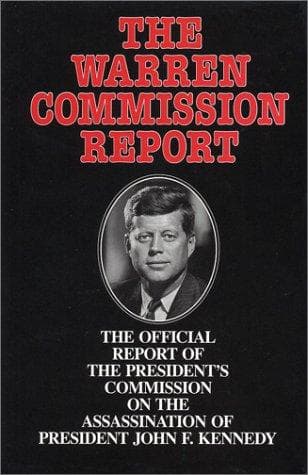
Report of the President's Commission on the Assassination of President John F. KennedyUnited States. Warren Commission
History
Report of the President's Commission on the Assassination of President John F. Kennedy
United States. Warren Commission
Kennedy, John F. (John Fitzgerald), 1917-1963 -- Assassination; Oswald, Lee Harvey
Surrey prepared the text for the handbill and apparently used Johnson
Printing Co. facilities to set the type and print a proof.[C6-498]
Surrey induced Klause, a salesman employed by Lettercraft Printing
Co. of Dallas,[C6-499] whom Surrey had met when both were employed
at Johnson Printing Co.,[C6-500] to print the handbill “on the
side.”[C6-501] According to Klause, Surrey contacted him initially
approximately 2 or 2½ weeks prior to November 22.[C6-502] About a
week prior to November 22, Surrey delivered to Klause two slick paper
magazine prints of photographs of a front view and profile of President
Kennedy,[C6-503] together with the textual page proof.[C6-504] Klause
was unable to make the photographic negative of the prints needed to
prepare the photographic printing plate,[C6-505] so that he had this
feature of the job done at a local shop.[C6-506] Klause then arranged
the halftone front and profile representations of President Kennedy at
the top of the textual material he had received from Surrey so as to
simulate a “man wanted” police placard. He then made a photographic
printing plate of the picture.[C6-507] During the night, he and his
wife surreptitiously printed approximately 5,000 copies on Lettercraft
Printing Co. offset printing equipment without the knowledge of his
employers.[C6-508] The next day he arranged with Surrey a meeting
place, and delivered the handbills.[C6-509] Klause’s charge for the
printing of the handbills was, including expenses, $60.[C6-510]
At the outset of the investigation Klause stated to Federal agents
that he did not know the name of his customer, whom he incorrectly
described;[C6-511] he did say, however, that the customer did not
resemble either Oswald or Ruby.[C6-512] Shortly before he appeared
before the Commission, Klause disclosed Surrey’s identity.[C6-513] He
explained that no record of the transaction had been made because “he
saw a chance to make a few dollars on the side.”[C6-514]
Klause’s testimony receives some corroboration from Bernard Weissman’s
testimony that he saw a copy of one of the “Wanted for Treason”
handbills on the floor of General Walker’s station wagon shortly after
November 22.[C6-515] Other details of the manner in which the handbills
were printed have also been verified.[C6-516] Moreover, Weissman
testified that neither he nor any of his associates had anything to do
with the handbill or were acquainted with Surrey, Klause, Lettercraft
Printing Co., or Johnson Printing Co.[C6-517] Klause and Surrey, as
well as General Walker, testified that they were unacquainted with
Lee Harvey Oswald and had not heard of him prior to the afternoon
of November 22.[C6-518] The Commission has found no evidence of any
connection between those responsible for the handbill and Lee Harvey
Oswald or the assassination.
Contacts With the Cuban and Soviet Embassies in Mexico City and the
Soviet Embassy in Washington, D.C.
Public-domain text, read in full here on John Shaqi.
Reviews
Reviews
No reviews yet
Be the first to share your thoughts on this work.
Elsewhere in the archive
Join the Discussion
Join the discussion
Sign in to leave a comment or review.
Sign InorCreate an account