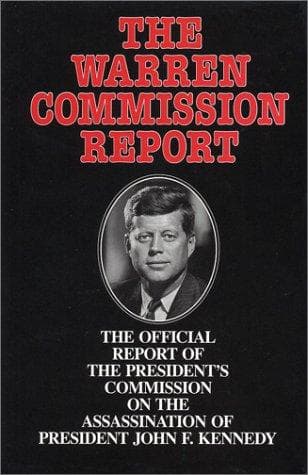
Report of the President's Commission on the Assassination of President John F. KennedyUnited States. Warren Commission
History
Report of the President's Commission on the Assassination of President John F. Kennedy
United States. Warren Commission
Kennedy, John F. (John Fitzgerald), 1917-1963 -- Assassination; Oswald, Lee Harvey
* * * she remembered * * * [that Lee Harvey Oswald] was the
name of an American who had come to the Cuban Consulate to
obtain a visa to travel to Cuba in transit to Russia, the
latter part of September or the early part of October of this
year, and in support of his application had shown his passport,
in which it was noted that he had lived in that country for a
period of three years; his labor card from the same country
written in the Russian language; and letters in that same
language. He had presented evidence that he was married to
a Russian woman, and also that he was apparently the leader
of an organization in the city of New Orleans called “Fair
* * * [Play] for Cuba,” claiming that he should be accepted
as a “friend” of the Cuban Revolution. Accordingly, the
declarant, complying with her duties, took down all of the
information and completed the appropriate application form;
and the declarant, admittedly exceeding her responsibilities,
informally telephoned the Russian consulate, with the intention
of doing what she could to facilitate issuance of the Russian
visa to Lee Harvey Oswald. However, they told her that there
would be a delay of about four months in processing the case,
which annoyed the applicant since, according to his statement,
he was in a great hurry to obtain visas that would enable
him to travel to Russia, insisting on his right to do so in
view of his background and his loyalty and his activities in
behalf of the Cuban movement. The declarant was unable to
recall accurately whether or not the applicant told her he
was a member of the Communist Party, but he did say that his
wife * * * was then in New York City, and would follow him, *
* * [Senora Duran stated] that when Oswald understood that it
was not possible to give him a Cuban visa without his first
having obtained the Russian visa, * * * he became very excited
or angry, and accordingly, the affiant called Consul Ascue
[sic], * * * [who] came out and began a heated discussion in
English with Oswald, that concluded by Ascue telling him that
“if it were up to him, he would not give him the visa,” and “a
person of his type was harming the Cuban Revolution rather than
helping it,” it being understood that in their conversation
they were talking about the Russian Socialist Revolution and
not the Cuban. Oswald maintained that he had two reasons for
requesting that his visa be issued promptly, and they were:
one, that his tourist permit in Mexico was about to expire; and
the other, that he had to get to Russia as quickly as possible.
Despite her annoyance, the declarant gave Oswald a paper * * *
in which she put down her name, “Silvia Durán,” and the
number of the telephone at the consulate, which is “11-28-47”
and the visa application was processed anyway. It was sent
Public-domain text, read in full here on John Shaqi.
Reviews
Reviews
No reviews yet
Be the first to share your thoughts on this work.
Elsewhere in the archive
Join the Discussion
Join the discussion
Sign in to leave a comment or review.
Sign InorCreate an account