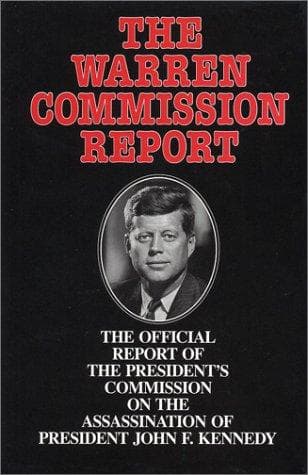
Report of the President's Commission on the Assassination of President John F. KennedyUnited States. Warren Commission
History
Report of the President's Commission on the Assassination of President John F. Kennedy
United States. Warren Commission
Kennedy, John F. (John Fitzgerald), 1917-1963 -- Assassination; Oswald, Lee Harvey
In contrast to the testimony of the witnesses who heard and observed
shots fired from the Depository, the Commission’s investigation has
disclosed no credible evidence that any shots were fired from anywhere
else. When the shots were fired, many people near the Depository
believed that the shots came from the railroad bridge over the Triple
Underpass or from the area to the west of the Depository.[C3-57] In
the hectic moments after the assassination, many spectators ran in
the general direction of the Triple Underpass or the railroad yards
northwest of the building. Some were running toward the place from
which the sound of the rifle fire appeared to come, others were fleeing
the scene of the shooting.[C3-58] None of these people saw anyone with
a rifle, and the Commission’s inquiry has yielded no evidence that
shots were fired from the bridge over the Triple Underpass or from the
railroad yards.
On the day of the motorcade, Patrolman J. W. Foster stood on the east
side of the railroad bridge over the Triple Underpass and Patrolman
J. C. White stood on the west side.[C3-59] Patrolman Joe E. Murphy
was standing over Elm Street on the Stemmons Freeway overpass, west
of the railroad bridge farther away from the Depository.[C3-60] Two
other officers were stationed on Stemmons Freeway to control traffic
as the motorcade entered the Freeway.[C3-61] Under the advance
preparations worked out between the Secret Service and the Dallas
Police Department, the policemen were under instructions to keep
“unauthorized” people away from these locations.[C3-62] When the
motorcade reached the intersection of Elm and Houston Streets, there
were no spectators on Stemmons Freeway where Patrolman Murphy was
stationed.[C3-63] Patrolman Foster estimated that there were 10 or 11
people on the railroad bridge where he was assigned;[C3-64] another
witness testified that there were between 14 and 18 people there as the
motorcade came into view.[C3-65] Investigation has disclosed 15 persons
who were on the railroad bridge at this time, including 2 policemen,
2 employees of the Texas-Louisiana Freight Bureau and 11 employees of
the Union Terminal Co.[C3-66] In the absence of any explicit definition
of “unauthorized” persons, the policemen permitted these employees to
remain on the railroad bridge to watch the motorcade. (See chapter
VIII, pp. 446-447.) At the request of the policemen, S.M. Holland,
signal supervisor for Union Terminal Co., came to the railroad bridge
at about 11:45 a.m. and remained to identify those persons who were
railroad employees.[C3-67] In addition, Patrolman Foster checked
credentials to determine if persons seeking access to the bridge were
railroad employees.[C3-68] Persons who were not railroad employees were
ordered away, including one news photographer who wished only to take a
picture of the motorcade.[C3-69]
Public-domain text, read in full here on John Shaqi.
Reviews
Reviews
No reviews yet
Be the first to share your thoughts on this work.
Elsewhere in the archive
Join the Discussion
Join the discussion
Sign in to leave a comment or review.
Sign InorCreate an account