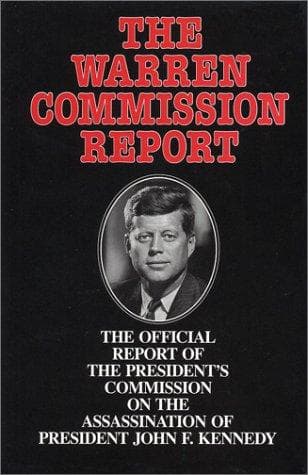
Report of the President's Commission on the Assassination of President John F. KennedyUnited States. Warren Commission
History
Report of the President's Commission on the Assassination of President John F. Kennedy
United States. Warren Commission
Kennedy, John F. (John Fitzgerald), 1917-1963 -- Assassination; Oswald, Lee Harvey
Four experts in the field of firearms identification analyzed the
nearly whole bullet, the two largest fragments and the three cartridge
cases to determine whether they had been fired from the C2766
Mannlicher-Carcano rifle found on the sixth floor of the Depository.
Two of these experts testified before the Commission. One was Robert A.
Frazier, a special agent of the FBI assigned to the FBI Laboratory in
Washington, D.C. Frazier has worked generally in the field of firearms
identification for 23 years, examining firearms of various types for
the purpose of identifying the caliber and other characteristics of the
weapons and making comparisons of bullets and cartridge cases for the
purpose of determining whether or not they were fired in a particular
weapon.[C3-136] He estimated that he has made “in the neighborhood of
50,000 to 60,000” firearms comparisons and has testified in court on
about 400 occasions.[C3-137] The second witness who testified on this
subject was Joseph D. Nicol, superintendent of the bureau of criminal
identification and investigation for the State of Illinois. Nicol
also has had long and substantial experience since 1941 in firearms
identification, and estimated that he has made thousands of bullet and
cartridge case examinations.[C3-138]
In examining the bullet fragments and cartridge cases, these experts
applied the general principles accepted in the field of firearms
identification, which are discussed in more detail in appendix X at
pages 547-553. In brief, a determination that a particular bullet or
cartridge case has been fired in a particular weapon is based upon a
comparison of the bullet or case under examination with one or more
bullets or cases known to have been fired in that weapon. When a bullet
is fired in any given weapon, it is engraved with the characteristics
of the weapon. In addition to the rifling characteristics of the
barrel which are common to all weapons of a given make and model,
every weapon bears distinctive microscopic markings on its barrel,
firing pin and bolt face.[C3-139] These markings arise initially
during manufacture, since the action of the manufacturing tools
differs microscopically from weapon to weapon and since, in addition,
the tools change microscopically while being used. As a weapon is
used further distinctive markings are introduced. Under microscopic
examination a qualified expert may be able to determine whether the
markings on a bullet known to have been fired in a particular weapon
and the markings on a suspect bullet are the same and, therefore,
whether both bullets were fired in the same weapon to the exclusion
of all other weapons. Similarly, firearms identification experts are
able to compare the markings left upon the base of cartridge cases and
thereby determine whether both cartridges were fired by the same weapon
to the exclusion of all other weapons. According to Frazier, such
an identification “is made on the presence of sufficient individual
Public-domain text, read in full here on John Shaqi.
Reviews
Reviews
No reviews yet
Be the first to share your thoughts on this work.
Elsewhere in the archive
Join the Discussion
Join the discussion
Sign in to leave a comment or review.
Sign InorCreate an account