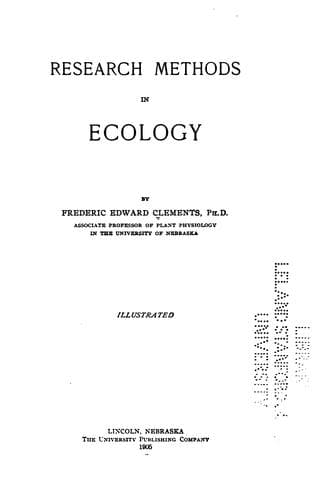
Research methods in ecologyClements, Frederic E. (Frederic Edward)
Science
Research methods in ecology
Clements, Frederic E. (Frederic Edward)
Plant ecology; Plant ecology -- Methodology
_Humidity_ ± _Water-content_ ±
Temperature ∓ Temperature ∓
Wind ∓ Wind ∓
Precipitation ± Precipitation ±
Pressure ± Pressure ∓
Soil texture 0 Soil texture
Altitude ∓ Porosity ∓
Capillarity ±
Slope ∓ Slope ∓
Exposure ∓ Exposure ∓
Cover ± Cover ±
=154. Response.= The normal functional responses to water stimuli are
absorption, diffusion, transport, and transpiration. Of these,
absorption and transpiration alone are the immediate response to soil
water and humidity, respectively. Consequently they are the critical
points of attack in studying the fundamental relation of the plant to
the water of its habitat. In determining the pathway of the response, it
is necessary to trace the steps in diffusion and transport, but, as
these are essentially alike for all vascular plants, this task lies
outside the scope of the work in hand. As previously suggested, the
relation between absorption and transpiration is strictly compensatory,
though, for obvious reasons, the amount of water transpired is usually
somewhat less than the amount absorbed. Absorption falls below
transpiration when extreme conditions cause temporary or permanent
wilting; the two activities are essentially equal after a growing plant
reaches maturity. In all cases, however, the rule is that an increase or
decrease in water loss produces a corresponding change in the amount of
water absorbed, and, conversely, variation in absorption produces a
consequent change in transpiration. This is strictly true only when the
stimuli are normal. For example, a decrease in humidity causes increased
water loss, which, through diffusion and transport, is compensated by
increased activity of the root surface. Frequently the water supply is
insufficient to compensate for a greater stimulus, and the proper
balance can be attained only by the closing of the stomata. In the case
of excessive stimuli, neither compensation suffices, and the plant dies.
Many mesophytes and all xerophytes have probably resulted from stimuli
which regularly approached the limit of compensation for each, and often
overstepped, but never permanently exceeded it. For hydrophytes, the
danger arises from excessive water supply, not water loss. There is a
limit to the compensation afforded by transpiration, which is naturally
dependent upon the amount of plant surface exposed to the air. No
compensation occurs in the case of submerged plants; floating
hydrophytes possess a single transpiring leaf surface, while the leaves
of amphibious plants behave as do those of mesophytes. The whole
question of response to water stimuli thus turns upon the compensation
for water loss afforded by water supply where the latter is moderate or
Public-domain text, read in full here on John Shaqi.
Reviews
Reviews
No reviews yet
Be the first to share your thoughts on this work.
Elsewhere in the archive
Join the Discussion
Join the discussion
Sign in to leave a comment or review.
Sign InorCreate an account